Showing posts with label storytelling. Show all posts

Friday, March 5, 2010

Fighting Hate With History

The Southern Poverty Law Center issued a report this week confirming that membership in extremist groups in the United States saw exponential growth in 2009.  The report, titled "Rage on the Right," said anti-government "patriot" groups saw a 244 percent increase in new groups in 2009 - with the total number of groups growing from 149 in 2008 to 512 (including 127 new militia groups) that year.
"This extraordinary growth is a cause for grave concern.  The people associated with the Patriot movement during its 1990s heyday produced an enormous amount of violence; most dramatically the Oklahoma City bombing that left 168 people dead."
--  SPLC Intelligence Report editor Mark Potok.
Hate comes in all forms, but at its root it's not complicated.   Change frightens people.  Cultural shifts in cultural norms related to skin color, language, religion and gender roles have rocked this country to its core on a regular, almost rhythmic, schedule.


One of the more recent of these shifts centers around sexual orientation.  As the overall climate of hate in this country has intensified, hatred specifically directed towards the LGBT community has intensified as well.

On one hand, this new climate has set the LGBT equality movement back on its heels.  Those working to pass marriage equality at both the federal and state levels have faced multiple setbacks.  Activists are still both stunned and frustrated in the aftermath of California's Proposition 8 still.  Larger LGBT organizations face uphill battles over ENDA and DADT.  LGBT individuals and communities are witholding political contributions around the country in protest.

On the other hand, though, it appears that the general pattern of social change is simply taking its course.  Before each breakthrough -the Suffragettes, the Civil Rights Movement, and others - the tectonic shifts of culture are inevitably preceeded by an intense moment of cultural conservatism.  As  change looms in the distance, those that are most opposed to its approach expend unusual amounts of energy to stop it.

I choose to believe that is where we find ourselves today.  This moment - as we face unprecedented backlash against the very idea that LGBT people could be legally and socially equal to their non-LGBT neighbors - is a necessary evil.  Our job is to survive it.  And to ensure that our community's children survive it free of the physical, psychic and social scars that so many of us have had to bear.

The truth is, there is only one way to survive intact.  And that is to carry our stories - our history - our truths - with us.  Without them, we have no community of our own.  We have no way to reassure our youth that they have solid, safe roots from which to draw strength when things get hard.

If we don't actively preserve our own stories, our community's history and legacy, we will lose them forever.  And we will lose a critical part of what we have been fighting so hard to acheive.  Political and legal equality will mean less if we don't collectively remember what it means to live without it.

The only way to win against those that are working so hard to destroy us, is to faithfully remember how far we've come - and that this is simply the last, painful - but so very necessary - step at the end of a very, very long road. 

----
There are many efforts underway to collect and preserve the LGBT history that is all around us.  A small handful of them are below. Please feel free to suggest additional resources in the comments section.

Saturday, February 6, 2010

Superbowl, Sexism and CBS

There's been a lot of discussion about CBS's rejection of the ManCrunch ad proposed for this Sunday's Superbowl game. Some have decided it was all a PR stunt (which, as someone in the PR business, I'm not entirely opposed to), and some have decided it's yet another indicator of how entrenched homophobia and sexism are in our society today (which, of course, is probably true).

[image source: mancrunch.com]

Both sides of the argument have a point. The fact that our culture is still so uncomfortable with the idea of two men kissing is precisely why this event has generated so much attention for ManCrunch.com.

From a PR perspective, ManCrunch was likely to get news coverage whether or not the ad ran this Sunday - a PR win regardless of the actual outcome. From a cultural perspective, there was likely to be some kind of backlash whether or not the ad ran this Sunday - confirming that we still have quite a way to go in our community's quest for acceptance.

From my perspective, though, the real question is whether all of this attention benefits our community as a whole. Is this the kind of storytelling that moves our message forward? Or does this create as many, if not more, problems than it solves?

Of course, I understand that many, many Superbowl ads play to the basest of our culture's sexist impulses. Women in bikinis are inexplicably used to promote technology products. Fast food retailers readily cast obese men, but will only consider emaciated female actresses to market their calorie-laden meals.

I'm certainly not suggesting that Superbowl ads are fair-minded, or culturally-sensitive as a rule. My concern is that the ManCrunch ad is a missed opportunity for our entire community. This is not an ad about same-sex love. It's an ad about sex. And while there's nothing wrong with sex per se, the ad's submission to (and subsequent rejection by) the Superbowl places it squarely in the existing public debate about whether same-sex love is worth protecting.


Rather than using this an opportunity to help put a human face on the validity of same-sex love and relationships in one of the most public forums available, I worry that the ManCrunch ad appears to reinforce the stereotype that gay men are purely sexual creatures. The ad suggests that a simple brush of the hand in a shared bowl of potato chips is enough to catalyze sexual aggression - leaving love and relationship dynamics out of the equation entirely.

What concerns me is that the LGBT community has no ability to offer a counterbalance to images as prominent as those connected to the Superbowl. We know for sure that, for the most part, people who are not themselves LGBT but know someone who is, are much less likely to vote against us when our issues are on the ballot. If this ad was our one shot to introduce the LGBT community to more mainstream Americans than ever before, I'm not sure it's worked to our advantage.

As a community, we can choose to connect with people in our own backyard, and show them that our rights are no threat to theirs – or we can take advantage of their fears and ignorance to further our own commercial enterprises.

The choice is ours, but the long-term impact of that choice must be weighed very, very carefully.

Wednesday, January 27, 2010

Don't Ask, Don't Tell Is More Than A Military Issue

With everything else going on - natural disasters, economic meltdown, foreign wars, and more - it might seem short-sighted to fixate on whether President Obama will choose to address Don't Ask, Don't Tell (the military policy that effectively prevents LGBT people from serving their country) in his upcoming State of the Union address on Wednesday evening.

[photo credit: ILRI Clippings]

I disagree. The impact of Don't Ask, Don't Tell on the LGBT community extends far beyond the military. The existence of an environment in which LGBT people are unable to tell their own stories underscores just how far we, as a community, still have to go.

At a basic level, it could be argued that our community only exists as a function of our personal, shared stories. LGBT people grow up, often with a vague feeling that we're somehow different, but we're not sure why. We come out, often in turmoil and fear. We live and love, often in the face of real danger and hardship.

It's these shared experiences, and our varied and personal stories about our journeys through them, that form the foundation of our community. We don't share gender or skin color or geography or language. There's nothing visibly apparent that binds us together. It is the telling of our stories - and our ability to find ourselves in each others experiences - that makes us who we are.

When we can neither ask about, nor tell, our stories we are effectively cut off from community. We are robbed of our ability to connect with one another. We are left isolated and vulnerable.

Whether President Obama addresses the military policy or not in his speech, the fact remains that LGBT people must have the right, and the ability, to tell our stories before we can truly make progress.

At Cause+Effect, our mission is to make sure that the stories of our community's shining stars, fearless leaders, and determined entrepreneurs are told. Their stories, their work, and their experiences, strengthen all of us.

Saturday, December 27, 2008

Twitter goes mainstream

Now that the O'Reilly Radar has released their latest report Twitter and the Micro-Messaging Revolution: Communication, Connections, and Immediacy - 140 Characters at a Time (O'Reilly, $249, PDF), Twitter and the "micro-messaging phenomenon" have officially gone mainstream.

A number of my clients have approached me about whether or not they should use Twitter, and I've posted about using Twitter professionally before and I use Twitter myself, but as Twitter moves more solidly into the mainstream, my guess is these types of inquires will start to come in even more frequently.

The simple truth is that while both technologies and tools come and go, the ability to effectively create a conversation and tell a story are the real keys to success, especially for those of us in PR.

Before your company and/or organization decides to actively engage in the "twitterverse", begin by finding out what people are saying about your organization and/or category in these active communities. Run a simple twitter search to find patterns in the existing conversation, or follow key thought-leaders in your industry anonymously to see how they use the tool.

Watch. Learn. Listen. Then – and only then – make a conscious decision about what you want to accomplish before diving in to the conversation.

As social media – including Twitter – moves to the mainstream, more and more users will begin to dive in to it without thinking through their objectives thoroughly. This is another opportunity to use the “POST” method pioneered by Forrester Research. POST is an acronym for “People, Objectives, Strategy, Technology” and it outlines the order in which organizations should build their online social strategy. (For more information on the POST method, click here.)

While I've long advocated for the value of social media as an effective, and increasingly relevant, PR tool - I've now begun to worry that its misuse could start to do more harm than good.

Update: 1/6/08 -
An excellent resource for using Twitter for Community and Communications professionals from Brian Solis @ PR2.0.

Monday, October 13, 2008

Storytelling During The Economic Crisis

There's an interesting article in today's AdAge that talks about why different corporations are maintaining their cause efforts during the economic crisis.

In a down economy, marketing is one of the first expenses businesses generally cut. The fact that cause marketing is being spared - or even increased - during this downturn speaks to how clearly corporations see their efforts to "do well by doing good" return value to their bottom line.

The key takeaway here is storytelling. Corporations that attach their product to a larger social conversation are able to create a story that resonates with their audience in a new, and powerful, way.

The example of the Campbell's soup cans above illustrates this well. Generally speaking, mothers buy soup. Generally speaking, women are primarily impacted by breast cancer. Buy tying the two together, Campbell's is able to reinforce the narrative that it cares about women, and that by purchasing it's soup, consumers can contribute to a fight they're likely to care deeply about themselves.

This entire narrative can be conveyed through a cause marketing effort in a much more effective way than through traditional marketing efforts. The storytelling matters. And companies aren't going to give up on that any time soon - no matter how bad the economy gets.

Tuesday, August 12, 2008

The Conversation Prism

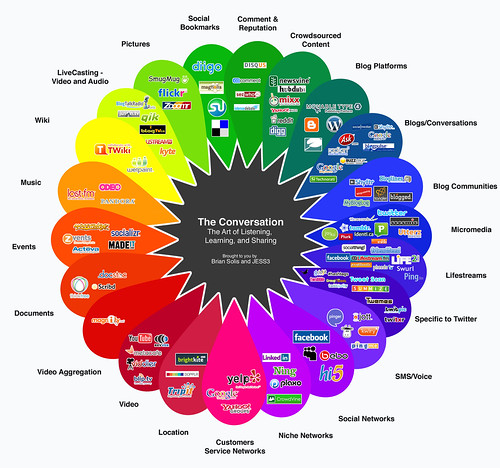
Brian Solis is one of the most widely respected practitioners at the intersection of social media technology and PR today. A few days ago, he posted an item on his blog called Introducing The Conversation Prism which explores how virtual conversations are happening today - taking in to account all of the different social media options available.


I've reposted the image here because I think it's probably the first comprehensive visual representation of the current state of social media. Which, by definition, means that it's absolutely ground-breaking.

For most of the media's history, the mechanics of conversation were simpler - but much less democratic. Broadcasters and publishers spoke to audiences, and audiences listened. Now that audiences are able to speak as well - through any mechanism that's comfortable to them - broadcasters and publishers (and the advertisers that fund them) are scrambling to learn how to listen and respond.

Solis says in his post:
If a conversation takes place online and you’re not there to hear or see it, did it actually happen?
Indeed. Conversations are taking place with or without you and this map will help you visualize the potential extent and pervasiveness of the online conversations that can impact and influence your business and brand. [...]
As conversations are increasingly distributed, everything begins with listening and observing. Doing so, will help you identify exactly where relevant discussions are taking place, as well as their scale and frequency.
Indeed.

Thursday, June 26, 2008

The Importance of Storytelling

I spend a lot of time discussing the importance of storytelling for both non-profit and for-profit communications on this blog.

[photo credit: luiginter]

Storytelling has also been a popular topic in the advertising industry lately. Today's Ad Age ran a piece entitled: (Author)ity: The Importance of Storytelling, in which they quoted Avenue A's recently published "Digital Outlook Report" which had this to say about the subject:
'Narrative is the experience. As the Web becomes the preferred destination for brand exploration, digital experiences must become richer, deeper, and more able to tell compelling stories. If your brand experience depends entirely on pages and clicks, it's time to wonder, 'What is my story?'
The thing that continues to strike me through all of these efforts to examine the role of storytelling within the worlds of business and philanthropy, is the sense that we need to justify the use of storytelling as a mechanism.

Culturally, we associate stories with children. We relegate them to the realm of fantasy and of entertainment. We don't consider them a tool. We don't take them seriously.

In fact, though, stories are the interface to the human brain. They provide the method by which we transfer data from one person to another. They are the keyboard plugged directly into our mental CPU.

Skilled storytelling allows us to take advantage of culturally-defined shortcuts on the keyboard - making data transfer that much more efficient and effective.

When we, as communicators, use familiar storylines (like the "fish out of water" tale, or the "journey to a distant land" tale) we can skip over known quantities, simply fill in a few bits and pieces of new information, and still effectively present a complex point. More importantly, because the end of these familiar stories are essentially pre-determined, our audience is more likely to accept our story's outcome as credible if it follows a familiar pattern.

Our culture's stories create the filing system that allow us to quickly access information. They provide the tools we use to distinguish good from evil, and fact from fiction. In fact, when we encounter cultures that don't share our stories, we are often entirely unable to communicate.

Stories are not limited to childhood. They define our everyday lives. Individuals, organizations and corporations that discount their value run the risk of failing to communicate altogether.

Sunday, April 20, 2008

When to Use Stories Instead Of Statistics

Kivi Leroux Miller posted recently about when to use stories rather than statistics to make your organization's case to potential donors, volunteers and supporters.

[photo credit: luiginter]

I've posted often about the value of storytelling in non-profit environments, and I'm pleased to see others making similar points. I've summarized Kivi's post (which is definitely worth reading in its entirety) below:
  1. What Do Other People Think About This Group?
    Answer with Testimonials.
    When someone is learning about you for the first time, they’ll be curious what other people think about your organization, your staff and your effectiveness.
  2. Are People Here Like Me?
    Answer with Profiles.
    When someone donates time or money to your organization, they are joining a virtual community of people who believe in the same cause.
  3. Does This Work?
    Answer with Success Stories.
    Do you get the job done? Are you going to make a difference with the money I give you? Success stories show donors (and potential new donors) exactly what it is you do and how you do it.
  4. What Difference Can a Single Person Make?
    Answer with Personalized Giving Options. Big problems are overwhelming. One way to overcome this problem is to focus on the difference that a single person can make and clearly demonstrate through storytelling that a new donor, as a single individual, can bring about change by supporting your organization.
  5. Can I Come Along?
    Answer with Personal Chronicles.
    For your supporters to fully engage with your nonprofit, you have to be willing to share what’s really going on.
Does your organization follow these simple guidelines when interacting with potential supporters? If not, it's worth making the effort to do so.

Friday, February 8, 2008

Press Release Basics

I've posted before about what separates a good press release from a bad one for non-profit organizations. It's been a while though, so I thought it might be helpful to revisit some basic principles of press-release writing in an easy-to-digest format.

Never forget that a press release is chance to tell a story. And any good story (and therefore any good press release) has the following elements:
  1. A central human story. If your release isn't about people - their lives, passions and struggles, it's a lot less likely to grab the attention of anyone - including the media. Start with the people in your story and deliver your message from their perspective.
  2. A central conflict. A great story requires conflict - something that must be overcome or resolved. Without conflict there can be no transformation, and without transformation your release is likely to fall flat.
  3. A beginning, middle and end. Your release has to answer the question "what happens next?" to grab your readers attention and keep them engaged. Begin by explaining who is telling the story, then discuss what conflict they're trying to resolve, then end with the outcome of that resolution. Skip a step, and you'll lose your reader's attention and interest.
  4. A way to find out more. The point of issuing a press release is to create a reason for the media to write about your organization. If you're successful, reporters will need to contact you to generate a story. Make it easy for them to find out more about your organization (see my earlier post about creating a media kit), and easy for them to contact you directly.
In terms of structure - your release should follow these standard conventions so that reporters can easily find their way through your information.
  1. Your organization's logo should be at the top of the page
  2. Your designated speaker (probably your ED) should be listed immediately underneath your logo along with their direct contact information (land line, cell phone and email address)
  3. When your release can be published (e.g., "For immediate release", or "Release Date: February 24th, 2008")
  4. Release headline (in all capital letters) and (optional) subhead (with the first letter of each word capitalized)
  5. Location and date of the release (e.g., "San Francisco, CA - February 24th, 2008") in bold text
  6. Leading paragraph (a short paragraph that acts as a summary of the release - assume that this is all the reporter will read before deciding whether to throw your release away - make it as engaging as possible)
  7. Body of release (try to keep it to a single page)
  8. A brief descriptive organization paragraph (begin the paragraph "About [orgname] - " in bold text) that describes what your organization does.
  9. Contact information (e.g., "If you’d like more information on this topic, or to schedule an interview with [designated speaker], please contact [name, email and phone number of scheduler for designated speaker].")
  10. A marker that the release is complete (the convention is to use "--- END ---", centered, at the bottom of the release). If you aren't able to keep your release to a single page (which is always preferred), be sure to use the tag (again, centered) "--- MORE ---" at the bottom of the first page, and then "--- END ---" at the end. This is a holdover from when most releases were faxed - and fax machines were notorious for only sending partial documents.
I hope this helps as you generate press releases for your organization. Good luck - and be sure to send me any success stories you might have!

Saturday, January 26, 2008

Creative Publicity

The point of publicity is to get your organization noticed. There's no one way to accomplish this goal, but smart organizations make sure there's always a steady stream of new news to report to the press, their supporters and their peers.


One way to keep the publicity pipeline full is to create a way to systematically collect compelling, relevant and fun stories from people who have a connection to your organization. A simple "tell us your story page" on your site (check out some examples here and here) is a great way to collect stories from your supporters that you can use for publicity purposes. Encourage users to submit their stories by adding a clear call to action on the front page of your site, in newsletters, and at events.

You can also encourage people to submit their stories by subtly suggesting topics in advance. A recurring list of "3 simple things you can do" - things that don't involve standard fare like writing a check or volunteering to stuff envelopes - in your newsletter could prod someone to take action, and could generate a great future story. Some ideas for your list could include:
  1. Use your wedding to raise money for charity [services like the I Do Foundation, and Travelers Joy make this easy to do]
  2. Throw a party for a cause [see my earlier post on that topic for more ideas]
  3. Write a letter to the editor [op-ed pieces are a great way to generate buzz - see my earlier post, or check out the great CCMC primer here]
Your organization's stories are some of it's biggest assets - don't miss out on the opportunity to collect as many of them as you can.

Wednesday, December 26, 2007

New Year's Resolutions

Now that Christmas is over, organizations can begin to look forward to 2008. Just like people, organizations should take this time to reflect on the past year, think through lessons learned, and focus on opportunities for the upcoming year.

One key resolution I'd suggest any organization consider, is to re-focus on telling their story in a way that really engages their audience - whoever that might be. Storytelling is the one thing that the non-profit world has going for it. For-profit companies pay public relations agencies top dollar to find new ways to tell compelling stories about the products they sell - most non-profit organizations have truly incredible stories just laying around the office.

Use storytelling to your advantage (read more posts about storytelling here) in 2008 by taking the time to create a visually engaging presentation that captures the heart and soul of your organization. Focus on the humanity, vitality, and impact of your organization. Pull the viewer in with images, music, color, voices, and anything else you can think of. Try it out on friends and neighbors - anyone who doesn't work with you - and see how they react. Keep the parts that provoke emotion. Ditch the parts that don't.

Above all - don't be boring. A quote and image from an excellent post by
My biggest pet peeve is boring nonprofit and foundation staff. Terrible PowerPoint presentations from someone from the social sector make me want to scream out “you have the most powerful and emotionally wrenching material out there and all you could come up with is this dry, picture-less, graph-filled PowerPoint about your 10 year strategic plan?!” People make award winning movies about the work that we do everyday, Al Gore’s PowerPoint won him the Nobel Peace Prize, and you can’t keep your staff and board members awake for a ten minute presentation?
January is generally a slow month for most non-profit organizations. Take the time now to do the work of polishing, reworking and adding emotion to your organization's story. It's a great way to start off the new year.

Saturday, December 15, 2007

Why storytelling matters

An excellent post on storytelling from Shoestring Creative Group reinforces once again why organizations need to focus on effective storytelling.

When it comes to communicating through storytelling, nonprofit organizations have a huge advantage over corporations and businesses. They WISH they had the stories you have. ... Marketing is crucial to your organization’s mission, not an extra thing that you have to do when everything else is already done. By approaching marketing communications as an integral part of reaching your mission, you can literally use marketing as a way to increase the capacity of your organization. If your marketing activities are not doing this, than you need to completely rethink what you are doing to get out your organization’s story.

The post highlights the biggest mistakes nonprofits make when trying to tell their organizations’ stories.
  1. They look at their organizations from their point of view rather than the view of the audience.
  2. They don’t get their story straight.
  3. They tell the wrong story to the wrong audience.
  4. They don’t answer the question , “SO WHAT?"
I would add one item to this list:
5. They don't include a way for the person hearing the story to get involved.
As part of your 2008 planning, your organization should take inventory of its own storytelling - and take the time to iron out any wrinkles that may have found their way into this critical part of its communications efforts. If your staff, donors, volunteers and recipients can't easily - and clearly - tell your story when asked, take the time to help them do so.

It's worth the effort.

Sunday, December 2, 2007

Storytelling and crisis management

Sitting in the hair salon today I overheard a stylist and his client say that this week's celebrity magazine cover story was "all public relations crap" - meaning that whatever celebrity was the subject of the story was clearly trying to undo some recent damage.

That, in a nutshell, is the problem. When a story rings false with only a quick glance at the headline, your public relations efforts have done more harm than good. Storytelling only works when your audience is able to receive the message of the story. If the story is rejected before it's message can be heard, it's not worth telling.

When crisis hits - and it will - sometimes the best strategy is not an outright denial. In those moments, it's often best to return to the agency's roots. Tell the one story that rings true no matter the circumstances - the story of the agency's mission, vision and purpose.

ShareThis