Showing posts with label fundraising. Show all posts

Tuesday, February 26, 2008

Distributed Funding - Keeping Track Of Online Giving

A number of online giving aggregators - sites that either track or bundle online donations - have sprung up recently adding even more momentum to the idea of distributed funding.

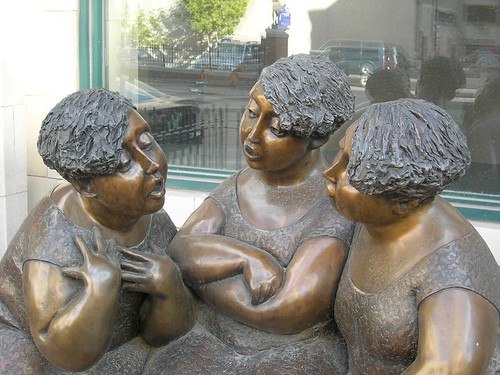
[photo credit: jenn_jenn]

A recent post at Xconomy points to three such sites:
  • Givvy - providing online tools that give individual donors “more control and more empowerment over why, when, where, and how they give to charities.”
  • Jackpot Rewards, a site that will donate half of its after-tax profits to children’s charities
  • Good2Gether - (which I've posted about before) a “hyperlocal giving aggregator”—an advertising-supported, keyword-based widget designed to appear alongside news stories on the websites of major regional media organizations, where it displays information about local non-profit fundraising campaigns or volunteer opportunities related to each article...."the non-profits get to make their pitch to a lot of readers, the newspaper website gets some ad revenue, and the advertisers get the glow of being associated with a humanitarian cause."
All three of these sites (and there are many others doing similar things) have a slightly different take on distributed funding, but all three share the idea that small donations can be combined to create meaningful impact.

For non-profits that have been in the habit of focusing on large, institutional donors for the bulk of their fund raising revenue, the model is changing. Not immediately, but sometime soon, the long tail theory will alter the face of traditional fund raising. Organizations that get ahead of this curve will benefit tremendously from it.

Thursday, February 21, 2008

The ROI Of WOM

I spend a lot of time on this blog talking about how non-profits can use social networking to their advantage. What's important to remember is that social networking is just a new way of generating word-of-mouth (or WOM) marketing.

photo credit: Dano

WOM is the one thing that money can't buy. It must be earned, cultivated, and maintained. the good news is that spreading the word is something that non-profits are good at anyway. In fact, non-profits are - for the most part - doing a better job of using Web 2.0 tools than their for profit counterparts, precisely because it's a natural thing for people that are engaged with a cause to talk about it amongst their peers.

It's not enough, though, to assume that your organization's word-of-mouth will take care of itself. The stakes are simply too high. Consider this post detailing the economic impact of Social Marketing from Esther Lim at the Crimson Consulting Group:
  • Companies enjoying higher levels of word of mouth advocacy such as HSBC, Asda, Honda and O2 - grew faster than their competitors
  • Companies suffering from low levels of word of mouth advocacy and high levels of negative word of mouth grew slower than their competitors
  • 7% increase in word of mouth advocacy unlocks 1% additional company growth
  • 2% reduction in negative word of mouth boosts sales growth by 1%
  • For the average company, a 1% increase in word of mouth advocacy equated to $16M extra sales

Source: London School of Economics, Harvard Business Review

I think it's fair to assume that these metrics translate from the for-profit, to the non-profit sector. What would your organization be willing to invest in terms of time and resources to achieve a 1% growth rate? For a $3 million dollar agency, that translates into $30,000 - the size of a respectable grant.

Friday, February 15, 2008

Distributed Funding - Some Early Statistics

As the idea of distributed funding becomes more mainstream, it becomes important to settle on some ways of measuring its effectiveness.

Slate recently posted an article on the topic, and points to some early statistics for electronic giving:
To date, sums raised have been relatively modest, though the trend shows movement in the right direction. According to the latest Chronicle of Philanthropy survey, electronic giving to the nation's largest charities, which has been growing at a rapid clip over the last five years, increased at an average rate of 37 percent in 2006. The portals Network for Good and JustGive.org, which allow donors to contribute to a variety of charities, saw increases in giving of 50 percent in 2007. And yet Internet giving still constitutes a tiny portion of total dollars raised—typically between 1 percent and 5 percent of an organization's overall contributions. Donating via social-networking sites (such as Facebook Causes, MySpace Impact, or any number of cause-related networks like dosomething.org or youthnoise.com) accounts for an even smaller share. The greater promise of viral philanthropy may lie not in electronic check writing, but in increased involvement; 21st-century technology for philanthropos in its most ancient sense.
The fact that electronic giving constitutes a small portion of overall donations shouldn't come as a surprise - it's still early in the game and most established individual contributors aren't accustomed to giving online. In contrast, new donors - younger people who are just beginning to become habitual givers, and those not local to a given organization - are much more likely to use the internet as they look for a cause to support. As these trends become more prevalent, organizations that show up online are much more likely to receive support. A robust presence in multiple locations online will make it that much more likely that your organization will be first in line to receive these new donors.

The key take away though is the idea of "increased involvement" as the most important outcome - check writing is actually byproduct of this primary goal. Engagement is critical for these new donors - and the way to get them engaged is to create an infrastructure in which they can interact with the organization and other supporters. Today, social networking is the best tool available to accomplish that. The tools may change over time, but the underlying trend will not.

Wednesday, January 30, 2008

Taking The Plunge

Todays Network for Good's Nonprofit Marketing & Fundraising Tips newsletter has an excellent list of tips for getting your organization started with social networking. The key message of the article - which I think is spot on - is this: "It's time to turn your message over to your constituents."


I couldn't agree more. There's no way for your organization's staff to reach out to everyone who might be interested in your work. You couldn't possibly find them all - let alone find a way to contact them. More importantly, people tend to pay attention to things that are introduced to them via a friend or trusted contact. While you may grow to play that role in the lives of your supporters - you certainly won't begin your relationship with them that way.

In truth, this is exactly how things have always worked for non-profit organizations. A small group of active supporters recruits new supporters from their circle of friends - those friends recruit new supporters - and so on. This same behavior has simply moved online. The only new element is that organizations now have the ability to fuel this word-of-mouth growth by providing supporters with web-based tools and information to pass along to their friends. It's a win-win situation - if you're willing to do the work it takes to create those tools and make them available online.

Here are the tips offered by today's newsletter (I've edited them down a bit for length) - all of which mirror my own previous posts on this topic -
  1. Pick one social networking channel in which to get involved. Try Change.org, Facebook or MySpace. Or set up a blog. [...] It's better to have a strong presence in one network than to spread your organization too thin across Web 2.0.
  2. Search the Change.org network, Facebook Causes or MySpace pages for a nonprofit with a similar mission as yours. See who their "friends" are and invite them to your cause once you're up and running.
  3. Make it easy for supporters to find you. [...] Name your social networking page exactly as your organization is named. Again, have a strong presence in one channel rather than all of them. [...]
  4. Build your [list of supporters..] give them a strong call to action to supply their email address to you so you can contact them later.
  5. [...] empower [your supporters] to share your charity with others: ask them to recruit friends to volunteer for you, create a charity badge and invite them to post it on their own blogs and social networking sites.
Network for good also has a good white paper on fundraising using social networking if you'd like more info.

Saturday, January 26, 2008

More On Distributed Funding

As I've mentioned before, movement of everyday interactions on to the web (also known as social networking, or Web 2.0) is changing the face of philanthropy by creating a new funding model that I'm calling "Distributed Funding."

PayPal is a natural platform for this type of funding and it's recently launched a promotion designed to encourage non-profits to use it's services to generate online donations rather than the many others out there (like Kintera or JustGive). As part of its promotion, PayPal is offering $50 to organizations that generate $500 in online donations using the PayPal donate button within a certain time window.


Another organization called good2gether appears to go one step further (they have yet to launch, so their service is a little tough to evaluate) by adding search into the mix. (An aside, their tag line is "Transforming Cause Into Effect" - but there's no relationship between Cause+Effect and their company).

All of the entrepreneurial activity in the sector - from both established players and recent entrants - points to continued growth for the "distributed funding" model. Non-profit organizations that establish pathways in this new frontier now will be much better off than those that don't.

Tuesday, January 8, 2008

PayPal Gets In To The Game

It looks like PayPal has joined the trend of providing badges and widgets for individual users to integrate into their own online profiles. A number of companies - like Network For Good and Chipin - are doing similar things, but the entrance of the financial juggernaut PayPal could change the conversation quite a bit.


A new PayPal Facebook application has popped up which allows users to both create a donation badge and track who else in their network has added the badge to their profiles. It's interesting not only because the average web user is likely to associate a certain amount of information security with the PayPal brand, but also because the Facebook integration allows a user to actually track activity on their network.

Privacy issues aside, this could be a new way for someone working on behalf of a non-profit to actually take full advantage of the network effect generated by online fund raising. Yet another example of why non-profits should be joining the activity on Web 2.0 sooner, rather than later.

Sunday, January 6, 2008

The World Wide Fundraising Web

I talk about how the internet has impacted communications within the non-profit sector a lot in this blog - and I'm certainly not alone (Beth Kanter, Sean Stannard Stockton, and Katya Andresen are all frequent commenters on this topic as well).

Mainstream media is also picking up on this theme these days. I just ran across this article in the Philadelphia Enquirer that I think makes some good points - so I wanted to pass them along to all of you -

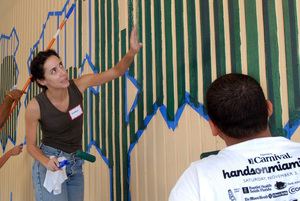
Photo credit: NOELLE THEARD / Miami Herald
Photo caption: Hands On Miami volunteers paint a mural at an elementary school. "Everything we do, our entire business model is built around the Web and our technology," said Pat Morris, president of the group.
Here are some of the key quotes from the article (in my opinion):
  • "There is no such thing as local anymore," said Ruth Shack, president of the Dade Community Foundation in Miami. "This new generation of givers are very, very different. They see themselves as change agents. . . . They are giving to issues. Global warming or breast cancer or whatever it is they feel close to."
  • "This new Web 2.0 approach - social-networking sites and that kind of thing - has really started to intensify for charities in the past year or two," said Stacy Palmer, editor of the Chronicle of Philanthropy magazine in Washington. "New charities are being created using those tools, and older, established charities are embracing them, too."
  • "They have a different notion of privacy than their parents, a different idea as to what information they share in a public forum like the Internet," he said. "Most adults I know aren't comfortable with these concepts. They place a greater trust in brands. The kids have a greater trust in their friends, and that's who they want to hear things from."
Have other thoughts on this topic? Add your opinions below in the comments section.

Saturday, January 5, 2008

Communicating With Online Donors

Should the way you communicate with your online donors differ from the way you communicate with other donors?


This great post at White Courtesy Telephone quotes a recent survey from Network for Good which notes the following:
  • Online donors give significantly more than offline donors.
  • Online givers are young, with men and women giving in equal numbers.
  • Donors are not new to giving, but they tend to be new to giving online.
  • Disaster relief is the leading category of giving and ranks among top searches; other leading giving categories are international causes, animal-related causes, human services and education.
  • Donors turn to the Internet at times of disaster and for year-end giving.
  • People seem to be at their most generous on weekdays, not weekends.
  • The number one reason donors say they give online is convenience: it is easier than writing a check.
If all those things are true, what should change about your outreach messaging? Your thank you notes? Your website's home page? If convenience is key, how can you make your donation process more convenient? How can you reassure new donors that their donations are safe?

It's a lot to think about, but it's worth it.

Thursday, January 3, 2008

Saying Thank You

Saying thank you after receiving a donation is one of the key elements of any fund raising campaign. It's also a kep element of any communications plan. Communicating your gratitude to your donors in an effective manner is as important as communicating any other message your organization has. In fact, the messages you convey to your donor audience might be some of the most important of all.

This month, Mal Warwick's newsletter includes this great list from Sandy Rees of ways to make sure your thank you's are hitting the mark. It's worth a read.

Enjoy -
---------

10 ways to energize your thank-you letters

By Sandy Rees

The thank-you letter often is created and sent without much thought. It may seem to be the last step in getting a gift from a donor and a routine task that warrants little merit. But it's actually the first step in securing the next gift!

Purposeful and well-thought-out thank-you letters can help you steward your donors, not to mention provide you with another way to communicate with them. Make sure you are getting the most from your thank-you letter efforts with these ideas.

1. Get the letter out quickly!
Everyone has probably heard that the faster you get your thank-you letters out the door, the better. That's absolutely true. A donor wants to be sure you received her gift, and a thank-you letter is the best way to let her know it arrived safely. Experts say to let no more than 48 hours go by from the time you receive a gift until the time you send out a thank-you letter. If it takes you a little longer and that's the best you can do, work with it. Figure out what will work for your organization and put a priority on getting the letters out the door.

2. Relate your thank-you letter to the Ask.
Instead of sending out a generic letter, customize your thank-you letter to the specific Ask that was used to generate the gift. If a gift comes to you from an appeal you sent out, then make sure your thank-you letter refers to the story or the text in the appeal. You may need to write several different letters that can be used for whatever you have going on. For instance, you may want to write one letter for a special event you're working on, another one for monthly givers, and another one for donors who respond to your newsletter. Relating the thank-you letter to the Ask is a way to let your donors know you are paying attention.

3. Tell the donor what you will do with their money.
This is critical. Make sure the donor knows how you plan to use the donation he or she just sent you. Text like "Your gift will ensure that 15 children will go to summer camp for one week" makes the process of donating tangible to the donor. He can envision 15 kids going to camp for a week, and it helps create a bigger feeling of satisfaction for him.

4. Use a real signature.
Digital signatures are easy and eliminate hand-signing a stack of letters. But technologically savvy donors know the difference between a digital signature and a live one. Have your President or Executive Director sign the letters, or ask a volunteer to sign them on his or her behalf. And use a blue pen so that donors can clearly tell it is a real signature.

5. Have the ED or President go through the letters and add personal notes.
This can bring big rewards in terms of stewarding donors! Taking a few minutes of a busy day to go through a stack of letters may seem like a chore to your boss, but donors who get a thank-you letter with a personal note will be thrilled that the ED took time to personally acknowledge his or her gift.

6. Add a reply envelope.
Don't be afraid to include a reply envelope in a thank-you letter. Many donors will hang onto these and use them for their next gift. You may receive some negative feedback, but you will likely receive a large number of gifts as well. It's not uncommon to receive thousands of dollars in gifts from these "bounce-back" envelopes. You may want to code these envelopes so that you can track the number, size, and amount of donations received using this technique. [Editor's note: Not all of us in the field advocate including a reply envelope in thank-yous. But it's a common practice and represents a matter of judgment.]

7. Include year-to-date or lifetime giving data.
For donors who have been giving for several years, this information can be very enlightening to them. A donor who gives a $10 gift regularly to your organization will immediately see how her gifts add up over time. Sometimes donors forget when they last gave. Including year-to-date information can be a gentle reminder for them if they have pledges or commitments to make.

8. Make it clear that the letter is also a receipt.
Don't you hate getting boring thank-you letters that drone on and never clearly spell out the gift you made? If you have to, draw a line on the page below the thank-you text and print "Gift Receipt" along with the actual gift information.

9. Include an offer to tour your facility or program site.
Always include in your letter an offer for a guided tour of your facility or program site. You may never have anyone take you up on this, but they will remember that you offered. You will probably get a few people who want to visit you. Seeing firsthand the work that you do may make all the difference in the world to a particular donor. It can also mean the difference in an average size gift and a major gift.

10. Include the name and contact info of someone the donor can call with questions. Make sure that person is available.
Donors want to be able to call and talk to a real, live, knowledgeable person when they have questions. So be sure to include the name and phone number in your thank-you letters of someone who can answer questions for them.

From the blog Step-by-Step Fundraising. Sandy Rees can be reached by phone at (865) 216-0083, at her Web site www.sandyrees.com, or by e-mail at sandy@sandyrees.com.

Thursday, December 27, 2007

Party with a Purpose

For a lot of us, the holidays bring with them a hectic social calendar. Company parties, holiday parties hosted by friends and other types of gatherings fill our schedules.

Your organization might be able to take advantage of this idea by partnering with board members, volunteers, or other supporters to turn an existing event into a fund raising party for you.

Author Morrie Warshawski contacted me recently about about his book "The Fund Raising Houseparty" (now in its 2nd edition) on this topic. It's certainly not a new idea (I've been to several parties like this myself), but it's good to know there's a straightforward how-to available as a reference for organizations looking to raise funds this way. Events can be tricky things, and one can never be too prepared. (For those of you in the Bay Area, he's also doing a workshop through CompassPoint on February 29th).


The book outlines five basic steps for a successful party:
  • people receive an invitation to come to a private home.
  • the invitation makes it clear that the evening will be a fundraising event for a specific nonprofit organization.
  • participants arrive and are served some refreshments.
  • participants sit through a brief presentation.
  • a peer--someone articulate, respected and enthusiastic--steps up and asks everyone present to make a contribution.
Both large and small organizations can benefit from a successful event because it serves as both a fund raising, as well as a branding, opportunity. Not only does the organization have the opportunity to walk away with funds it probably would have missed, it also has a chance to tell its story to a captive, and pre-screened, audience. Better still, it's a relatively painless way to get Board Members to participate in the organization's fund raising efforts.

If your organization is considering a house party, I would add these ideas to the book's suggestions:
  • Start with storytelling. Your stories are your main assets - if there's a way to have them displayed around the space so attendees can absorb them throughout the evening, do so. Incorporate them into your live presentation. Create small take-away items that attendees can share with others after the event.
  • Discourage anonymity. Peer pressure is a powerful tool in these types of settings. If each donation is publicly visible (donors might get a sticker on their lapel, or may be asked to stand for applause), those who have not yet committed to donate will feel pressure to do so.
  • Identify new donors. The room will likely be filled with some who are familiar with your organization and some who are not. Create a visual way to distinguish between these two groups so newcomers know who to ask if they have questions, and staff can easily engage new prospects.
Have other suggestions, ideas or success stories on this topic? Add a comment to this post to share your ideas with other readers.

Wednesday, December 19, 2007

10 Tips for Year-End Fundraising

This article is taken from this week's Groundspring email newsletter. For some reason, they don't appear to publish the newsletter online, so I've copied it below for your reference.

Enjoy!

------------------


Millions of Americans will be thinking about last-minute tax deductions from December 26-31, which makes this the single best week of the year to email your prospects and ask for a donation. Last December 27, Network for Good sent a one-sentence reminder to donors which returned an average $50 donation for every email sent. With December half over, it's now or never for planning these year-end fundraising emails. Here's how:

1. Construct your message: As you write your year-end appeal, remember that there are four components to a great message: connecting with your audience based on their values, rewarding your audience, asking for a specific action to get that reward, and making it memorable. Remember this with the mnemonic device CRAM, and these four easy steps. More details here.

2. Frame your call-to-action to answer four questions: To grow your donor base and total donations, your year-end appeals need to have an appropriate "Call to Action." As you craft your call to action, make sure you answer these four questions. More details here.

3. Ask people who have not given recently to make a year-end donation. Ask those who have to consider making a gift in somebody’s name or to make another contribution for tax benefits or specific year-end programs.

4. Have your supporters get their friends and family involved. Your biggest supporters care about your cause and want to further it. Additionally, people heed the advice and examples of somebody they know and trust. Ask them to ask for support on your behalf, through programs like America’s Giving Challenge. More details here.

5. Clearly show how a donation will make a difference; if you’re a homeless shelter include pictures from the previous year’s holiday meal that donations enabled.

6. Add some cheer to your emails with these holiday themed "Donate Now" buttons. More details here.

7. Format your emails appropriately to ensure everyone receives, opens and reads them. Here are 18 ideas to improve your delivery, open, and response rates. More details here.

8. Finally, always thank your donors. Multiple times. The most common reason a person stops giving to a charity is how they were treated by that carity. Thank your supporters, show them how they made a difference and cultivate them for the future.

9. Don't have a fundraising page? We can create a Custom DonateNow fundraising page that looks like your website in as little as 48 hours for only $29.95/month. More details here. No budget? To create your organization’s free Basic DonateNow page, simply add your organization's EIN to the end of the following URL:

https://www.networkforgood.org/donation/ExpressDonation.aspx?ORGID2=yourEINgoesHERE
(Example: https://www.networkforgood.org/donation/ExpressDonation.aspx?ORGID2=680480736)

10. Need an example of a fundraising email? Here's an email we received this week from The Leukemia & Lymphoma Society. More details here.

Monday, December 17, 2007

Distributed funding - a new model for philanthropy

An article in the Washington Post today underscores one of the key recent trends in philanthropy -- distributed funding.

While foundation-based and major-donor funding are certainly as important as they've ever been, social networking has introduced the idea of generating small dollar amounts from a very large base of supporters as an alternative to more standard practices.

The company featured in the Post article is called Razoo, but there are many others vying for space in this emerging market - including Steve Case's foundation on Facebook (which i talked about in an earlier post), JustGive.org, DonorsChoose.org, Network for Good, SixDegrees, Changing the Present, and many, many others.

Razoo represents an offshoot of the basic concept because it focuses attention on how technology and philanthropy are intersecting with the start-up, for-profit culture of the Internet.

Razoo is a company that has built a Web site to connect people with one another, much like social networking giants MySpace and Facebook, but in support of humanitarian objectives such as preventing homelessness in the United States and helping families who live in a Nicaragua trash dump. Users and causes each have their own pages.

"YouTube is transforming TV. Google has transformed advertising," said Razoo founder J. Sebastian Traeger. "The Web will do the same thing for philanthropy."

The point here is that non-profits have tended to spend a great deal of time cultivating larger donors, and have tended to invest less time cultivating the smaller ones. Given the changing technology landscape, organizations will need to rethink that strategy very, very soon. Tapping in to the deep ocean of donors on the internet is likely to spell financial success for those organizations who reach them sooner, rather than later.

Tuesday, December 11, 2007

Gift Giving 2.0: Give the Gift that Keeps On Giving

Techsoup (a technology site for non-profits) will be hosting an online forum all day on December 13th called Gift Giving 2.0: Give the Gift that Keeps On Giving, taking place in TechSoup’s Technology for Fundraising forum.


It's a great opportunity for any non-profits who are looking to make a last minute push for seasonal donations. Now that the number of shopping days before Christmas are running out, people are beginning to look for quick and easy ways to give gifts online. The two hosts of the forum, Robert Tolmach of ChangingthePresent.org and Caroline Bernadi of Maatiam, will be on deck to explore how non-profits can benefit from using cause-related shopping sites. They’ll discuss how your gift giving sites can be a fundraising boost not only during the holiday season, but all year long.

The free all-day, asynchronous (not-live) online event will discuss issues such as:
  • What gift giving sites are out there and how do they work?
  • How your nonprofit can make the most of cause-related shopping sites
  • Are the benefits of gift giving sites worth the time investment?
  • Tips and suggestions for using gift giving sites as part of your fundraising strategy

To join in the forum, go to techsoup.org/go/giftgiving. No registration is needed, just show up and post your questions - or browse the questions and answers that are already there.

Sunday, December 2, 2007

A Very Good Gift

Thanks to Katya's Non-Profit Marketing blog for this post
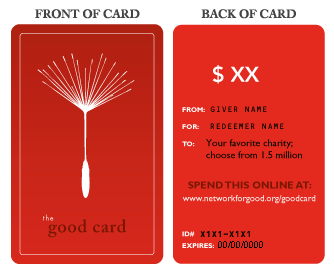
The Good Card is a gift card for charity – where the recipient gets to donate to their charity of choice. That includes ANY charity with registration in the US – up to 1.7 million. Customers, clients, employees, friends and family all have their favorite charities and now you can give them the perfect gift – a donation to their favorite charity via Network for Good’s secure giving system.


What a great idea for the holidays - definitely something worth giving and getting.

ShareThis