Showing posts with label social networking. Show all posts

Thursday, May 7, 2009

The real difference between Twitter, Facebook and MySpace

For the last several months, every new client that's come to Cause+Effect has wanted to know the same thing - how are they supposed to decide which of today's most popular social networking sites - Twitter, Facebook and MySpace - they're supposed to use? What's the difference between them. And why are they suddenly being expected to manage so many different things all at once?

It's a good question. Six months ago most people in this country hadn't heard of Twitter, and thought only their kids used Facebook and MySpace (my mother conveniently calls the entire concept of social networking "My FaceSpace" - which I find adorable). Today, Oprah has introduced the concept of Twitter to the masses, Facebook drives more traffic on the web than Google, and MySpace is considered the future of the music industry.

[photo credit: psd]

Here's the thing. It's still just a giant conversation. As new as all of this seems - the truth is that human beings have conversations all the time. All different kinds of conversations. In all different kinds of places.

For a long time, the web was simply about listening. We read articles, we played games, we looked for portals that helped organize information. The introduction of social networking sites has allowed us to return to our conversational roots. It allows us to talk to each other. Because of that, it feels oddly familiar, but because it's online it often feels odd.

The trick is to relate these new online conversations back to our more familiar offline ones. Once we do that with our clients, their eyes light up and suddenly the whole idea doesn't seem nearly as daunting.

Here's our approach to social networking strategy at Cause+Effect:

Facebook conversations = Dinner conversations

This is a simple, and effective explanation of Facebook. We started using it several months ago, and it does the trick every time. Simply put, because the idea behind Facebook is to connect people that *already* know one another, conversations on Facebook follow similar rules as do those amongst friends and acquaintances around a dinner table.

The rules are:
- Be polite (Keep shop-talk and self-promotion to a reasonable minimum)

- Be interesting (Share items that others might find interesting to keep the conversation going. Personal tidbits, interesting current events, and quirky stories are all acceptable.)

- Be upbeat (Although it's likely that everyone at the table generally shares similar backgrounds and values, keep controversy to a minimum to help keep the conversation pleasant and light.

Twitter conversations = Cocktail party conversations

Because the idea behind Twitter is to allow you to connect people that you find interesting, but don't necessarily know, conversations on Twitter follow similar rules as do those amongst relative strangers at a professional or social mixer or cocktail party who have all been drawn to the event because of a shared interest or expertise.

The rules are:
- Stay on topic (On Twitter people are following their interests, rather than existing relationships. For that reason, people who demonstrate that they are the best sources of fresh, interesting information on a particular topic quickly develop the largest followings. Self-promotion, to the extent that it's useful and relevant to the conversation, is ok. Pure self-promotion, however, will get you ignored entirely.)

- Mingle (Conversations evolve organically on twitter, just like they do at a cocktail party. To be a part of the best conversations, you have to be sure you're moving around the room and keeping your ears open. Twitter has developed ways to track conversations using hashtags, retweets, and other loosely defined conventions to help users follow topics that matter to them.)

- Take turns (Good cocktail party conversations aren't dominated by one voice, be sure to find and follow others that are tweeting on topics that interest you and then dive in when you have something useful to say.)


MySpace conversations = High school cafeteria conversations

Because MySpace is all about self-expression, conversations on MySpace follow similar rules as do those amongst teenagers in a high school cafeteria. Conversations revolve around sharing personality driven topics - like music, art and fashion - rather than more content heavy topics like news and politics. People with similar tastes, who may or may not have a real-world relationship, are drawn to one another based on their aesthetic similarities.

The rules are:
- Express yourself (Invest time and energy in presenting a virtual persona that visually and functionally represents your best self. Keep it fresh and current on a regular schedule. It's your primary source of credibility.)

- Find your tribe (Find others who share your interests, reach out and make connections.)

- Interact (Not only do you have to keep your own persona fresh and relevant, you have to show the other members of your tribe that you are an active member of the group that contributes to the group's cohesion and overall cool-factor.)

The rules are familiar because at their core, they haven't changed at all. And the truth is, they apply whether the conversation happens in the real world or the virtual one.

They key - as always - is to know what kind of conversation you're having before you open your mouth.

Monday, February 2, 2009

Who's Online? Everyone.

The Pew Internet & American Life Project just published their Generations Online report for 2009 and it's worth a read (hat tip to Shabbir Safdar @ Virilion Inc. for publishing a link to the report in his latest newsletter)

The report challenges the idea that young people represent the bulk of users online. According to their research, each generation is as active online as any other - they're just using the internet for different things. Teens and Generation Y find entertainment and social networks online. Older generations use the internet as a tool for research, shopping and banking. Both the younger and older generations go online to do research.


Many of my clients are hesitant to expand their online outreach strategy much beyond a basic website and a monthly email newsletter (indeed, sometimes it's a challenge just to execute those two effectively). In today's internet, however, these two are clearly not enough. SEO, social media, interactive tools, and online word of mouth, are need to be critical components of any online strategy.

This research reinforces that no matter who your current audience is, and no matter which new audiences you are trying to reach, your more likely to find them online than anywhere else.

Which begs the question, what are you doing - right now - to create and execute a comprehensive online presence for your organization?

Wednesday, January 7, 2009

Credit where credit is due

The funny thing about using social media for PR, is that we sometimes end up caught between two opposing paradigms.

Generally speaking, writers/reporters/editors would prefer if PR were an invisible part of the process. At the end of the day, we're all working to ensure that the final written product appears to be the journalist's, rather than the publicist's, creation.


Social media, on the other hand, works in the opposite way. The network itself finds a way to encourage views of content it deems to be useful, relevant or interesting - for whatever reason. Information - oftentimes supplied by a publicist - gets retweeted, dugg, shared on facebook and myspace, and otherwise moved up the chain of online relevance. The content of the article is what matters - not necessarily the source.

Which is exactly why using social media for PR purposes is so refreshing. Anyone - a non-profit organization, a consumer products company, or a publicity firm - can circulate information online. The only requirements are that:
  1. The content matters to your audience
  2. The content is complete, relevant and timely
  3. The content is easy to navigate and share
Take advantage of the wide-open social media paradigm. Unlike the traditional PR/press paradigm, there's literally nothing standing in your way.

Saturday, December 27, 2008

Twitter goes mainstream

Now that the O'Reilly Radar has released their latest report Twitter and the Micro-Messaging Revolution: Communication, Connections, and Immediacy - 140 Characters at a Time (O'Reilly, $249, PDF), Twitter and the "micro-messaging phenomenon" have officially gone mainstream.

A number of my clients have approached me about whether or not they should use Twitter, and I've posted about using Twitter professionally before and I use Twitter myself, but as Twitter moves more solidly into the mainstream, my guess is these types of inquires will start to come in even more frequently.

The simple truth is that while both technologies and tools come and go, the ability to effectively create a conversation and tell a story are the real keys to success, especially for those of us in PR.

Before your company and/or organization decides to actively engage in the "twitterverse", begin by finding out what people are saying about your organization and/or category in these active communities. Run a simple twitter search to find patterns in the existing conversation, or follow key thought-leaders in your industry anonymously to see how they use the tool.

Watch. Learn. Listen. Then – and only then – make a conscious decision about what you want to accomplish before diving in to the conversation.

As social media – including Twitter – moves to the mainstream, more and more users will begin to dive in to it without thinking through their objectives thoroughly. This is another opportunity to use the “POST” method pioneered by Forrester Research. POST is an acronym for “People, Objectives, Strategy, Technology” and it outlines the order in which organizations should build their online social strategy. (For more information on the POST method, click here.)

While I've long advocated for the value of social media as an effective, and increasingly relevant, PR tool - I've now begun to worry that its misuse could start to do more harm than good.

Update: 1/6/08 -
An excellent resource for using Twitter for Community and Communications professionals from Brian Solis @ PR2.0.

Tuesday, August 12, 2008

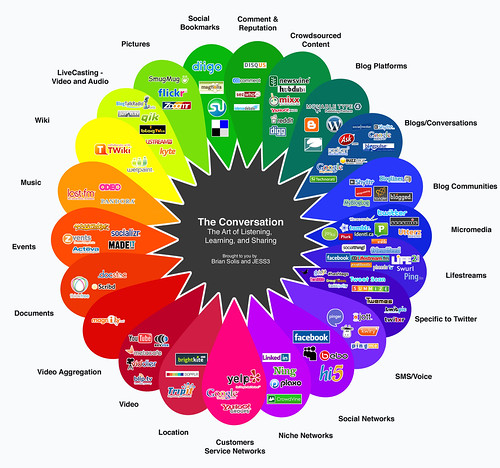
The Conversation Prism

Brian Solis is one of the most widely respected practitioners at the intersection of social media technology and PR today. A few days ago, he posted an item on his blog called Introducing The Conversation Prism which explores how virtual conversations are happening today - taking in to account all of the different social media options available.


I've reposted the image here because I think it's probably the first comprehensive visual representation of the current state of social media. Which, by definition, means that it's absolutely ground-breaking.

For most of the media's history, the mechanics of conversation were simpler - but much less democratic. Broadcasters and publishers spoke to audiences, and audiences listened. Now that audiences are able to speak as well - through any mechanism that's comfortable to them - broadcasters and publishers (and the advertisers that fund them) are scrambling to learn how to listen and respond.

Solis says in his post:
If a conversation takes place online and you’re not there to hear or see it, did it actually happen?
Indeed. Conversations are taking place with or without you and this map will help you visualize the potential extent and pervasiveness of the online conversations that can impact and influence your business and brand. [...]
As conversations are increasingly distributed, everything begins with listening and observing. Doing so, will help you identify exactly where relevant discussions are taking place, as well as their scale and frequency.
Indeed.

Sunday, July 13, 2008

Marketing vs. Conversation

Social Media Today ran a great post recently dealing with the difference between marketing and conversations.

The core message of the post was:
"Conversations are between two or more people. If marketers want to create buzz throughout the social web then they’d better represent a product/service that exceeds people’s expectations. Otherwise trying to interrupt conversations with a product or service that hasn’t performed well may in fact turn the conversations against you."
This is a key point that many organizations miss when they dive in to social networking. It's not enough to join in the conversation. You actually have to have something to say.

Social networking is not an internet phenomena - it's simply an extension of everyday conversations into an electronic medium. Just like at a cocktail party, if you were to walk up to a group of people that are already talking, you'd come off as odd if you were to immediately start speaking about something that's off-topic. Eventually the group would ignore you, and eventually they would shut you out of their conversation altogether if you didn't stop talking.

If you're trying to draw attention to your organization, project or idea in a social networking environment, begin by listening. Only chime in when you have something valuable to add to the conversation.

It's a good rule of thumb both online and off.

Friday, May 23, 2008

Creating Conversations

Many organizations have experimented with various social technologies, ranging from maintaining blogs to setting up profiles on popular social networking sites. The most successful of these efforts were originally designed as part of an ongoing effort to create a constant, two-way conversation between the organization and its constituents. The technology is merely a vehicle for that conversation, the conversation itself is the objective.

photo credit: Dano

The key is to ensure the conversation clearly connects to the organization’s larger objectives. Any conversation that occurs in a vacuum, whether online or off, simply isn’t sustainable. A generally accepted way to design a successful online social strategy is the “POST” method pioneered by Forrester Research. POST is an acronym for “People, Objectives, Strategy, Technology” and it outlines the order in which organizations should build their online social strategy.

People
How do the people that your organization is trying to reach use technology? Are they already using Facebook and MySpace? Have they discovered Twitter? Are they joining groups online? Do they rely more heavily on email and listservs? What is changing about their behavior?
Task: Design, distribute and analyze a survey to gather information about the online habits of your organization's target audiences.

Objectives
Given how your audiences use technology, what are your organization's objectives for implementing a social technology strategy? In general, Web 2.0 technologies allow organizations to more efficiently and effectively listen to their existing constituents, talk to new constituents, and energize and support existing constituents and staff.
Task: Articulate both the short-term and long-term objectives that your organization is trying to achieve through this effort. Assign measurable goals to each stated objective.

Strategy
After identifying your objectives, what is your strategy to achieve them? A deep understanding of which Web 2.0 technologies and approaches work for which objectives is the best place to start.
Task: Explore and evaluate existing technologies such as MySpace, Facebook, blogging software, listservs, online groups, and others. Map the strengths and weaknesses of each relative to your stated goals and available resources.

Technology
Once the other steps are done, then your organization will be able to focus on which technologies to use, and how to structure the implementation of each technology option.
Task: Choose those technologies which are most likely to help your organization achieve its stated objectives. Determine tasks, agree to timelines, and assign responsibilities.


Once complete, your organization's social networking strategy will help create an online arena for people to ask and answer questions, share their stories, and find support. It will help position your organization as a trusted resource, and handy reference. It will also help position your organizations as a technologically savvy, state-of-the art institution.

Monday, April 21, 2008

Who's Talking About Your Organization?

Did you ever wish you could be a fly on the wall – listening to what your members, donors and supporters are saying about you when they're casually chatting with their friends and neighbors?
[photo credit: psd]

Hopefully, they're saying nothing but good things about your organization – but what if they're not? What if they're passing along outdated or incorrect information? What if they're griping about things you could easily change if you only knew?

Social media (aka "social networking") – including Twitter, Facebook, Flickr, YouTube and others – has created an enormous, global, non-stop conversation. Some of those conversations might be about you - and if they are, wouldn't you want to know?

There are a number of ways to keep track of online conversations that are about your organization. I've posted before about using Google Alerts as a tool for precisely this need, but some new tools have emerged, including TweetScan and Yahoo!Pipes (note: creating a new Yahoo!Pipe is definitely for more advanced users - but the Social Media Firehose Pipe is already set up and very easy to use). With all this information at your fingertips, it's worth taking the time to find out what people have to say.

Jason Alcorn and Shabbir Imber Safdar wrote a wonderful case study that illustrates how keeping track of what people are saying in the social media universe can help make a difference in your organization's communications strategy.

Now more than ever, knowing really is half the battle.

Monday, March 24, 2008

Taking A Lesson From Starbucks

Starbucks recently waded into Web 2.0 with its new offering mystarbucksidea.com. The site is designed to allow Starbuck's customers to post, share and discuss their ideas about the company and its products.


I spend a lot of time on this blog encouraging my readers to find ways to do exactly what Starbucks is attempting to do here. In an interactive world, it's critical that both corporations and organizations find ways to have conversations with their constituents in a meaningful and transparent way.

The Starbucks site, however, serves as a somewhat cautionary tale. By creating a online "suggestion box" without also imposing a clear structure, Starbucks risks missing out on hearing clear, focused comments from its users. The site is already being criticized for being "unwieldy" — with "lots of wayward ideas ... suggested [and] repeated numerous times in various categories." Some commentators have said "with so many ideas flooding the site, it makes it more difficult for Starbucks to listen and to follow-through on the suggestions."

The question to ask here is what exactly Starbucks was trying to do. It's often not enough to simply ask for feedback. Generally speaking, people that don't work at your company or organization don't spend that much time thinking about your business/cause unless they've had a very personal experience - whether negative or positive - with it. Asking for general feedback might solicit their individual story, but it probably won't generate much constructive insight. Instead, do your own homework. Create structured questions that can be thoughtfully answered by your supporters - and generate suggestions that can truly benefit your organization.

If your organization has a blog or a newsletter, ask your supporters one question each month and then report back the following month with the best 3 answers/suggestions. Be specific. Ask whether your organization's messaging could be updated for a multicultural audience. Ask what your organization could be doing to reach out to a neighboring city. Ask how to get young people involved as volunteers during their summer break.

Creating a conversation is only helpful if everyone stays on topic, and if you can hear what everyone's saying. If you make the effort to begin a conversation with your constituents, be sure to do so in a way that benefits them, as well as your organization.

Tuesday, March 4, 2008

What Is Social Media?

I ran across this definition of social media today from Erica O'Grady:
Social Media is NOT about technology or Web 2.0 applications. Social Media is Word-of-Mouth or Community Based Marketing that leverages technology to enable conversation.
I couldn't agree more. So many of my non-profits clients shy away from my recommendation to use social media tools (a.k.a. "social networking tools") to communicate with their constituents because they're afraid of new technology.

As Erica's definition above confirms - it's not about the technology. It's about the conversation. When the technology can make the conversation easier to have - and allows more people to be involved in it - then it's the best tool for the job.

Saturday, March 1, 2008

PR 2.0

The idea that the web has moved away from a one-way conversation (corporate web sites, newspaper articles online, etc.) and towards a multi-layered conversation (users creating and uploading their own content, reviewing products and experiences, and commenting on articles published by traditional media sites) is fairly well established at this point. Generally, you'll hear people call this shift "Web 2.0."

Sarah Lacy's upcoming book Once You're Lucky, Twice You're Good: The Rebirth of Silicon Valley and the Rise of Web 2.0 is destined to be the definitive work on this idea.
When her book hits the shelves in May, it's likely to make a lot of non-Silicon Valley types examine exactly how this technological shift impacts the world around them.

For those of us in PR, the shift has been happening for quite a while. Brian Solis fixed the term PR 2.0 in the lexicon when he began a blog of the same name in April of 2006, and Todd Defren has been monitoring the impact of the new web on the communications industry from his vantage point at Shift Communications for the past several years. Of course there are hundreds of other pundits and commentators as well - far too many to mention here.

The point is, they're all saying the same thing. More and more people have stopped simply receiving information and have begun to actively create it. More and more people now get their information from sources that didn't even exist 5 years ago.

My own information habits have changed drastically over the last few years. My morning hours are now spent absorbing information via blog readers, minute-by-minute updates from both industry leaders and personal friends via Twitter and Facebook, broadcast news delivered via TiVo, and radio news delivered via podcast. At no point do I interact with traditional media in any way. And the same is true for most of my peers.

For the PR industry, this poses a particular problem. Since we're in the business of feeding information into an existing distribution structure, what happens when the structure shifts? The answer: We must shift as well. And fast.

While it used to be sufficient to send a standard press release to a set of wire services - now both the release itself, as well as the distribution mechanism, are in flux.
  • Social Media Releases - Not all content creators are journalists. Journalists are trained to tell stories. Bloggers, pundits and analysts are much more interested in tracking industry changes one fact at a time. Traditional press releases are designed to tell the whole story at once. Social media releases just list the facts, key quotes, and critical issues.
  • Social Media Optimization (SMO) - Just as search engine optimization (SEO - which I posted about earlier this month) is a critical component of any web strategy, optimizing your publicity efforts so they can be easily spread by supporters using social media sites is now critical as well.
If your publicity efforts are stuck in Web 1.0, now is the time to make a change. Otherwise you might find that you're still communicating, but no one's listening.

Tuesday, February 26, 2008

New Features on Facebook Causes

I got this email today from the Causes application on Facebook:

Dear Cause Administrator,

Since you started a cause on Facebook, you might be interested in an exciting new Causes feature. If you work for the nonprofit for which you started your cause, you can now claim your official Nonprofit Profile on Facebook.

To do so, just submit a nonprofit partner application here:
http://www.causes.com/partners/partners/new

By claiming your profile you become a nonprofit partner, which allows you to control all of your interactions with Causes on Facebook from one central dashboard. Here you can edit your official Nonprofit Profile, select official and featured causes, keep track of all causes benefiting your nonprofit, see a list of all recent donors, and download donor contact information.

If you don't work for a nonprofit but are in touch with someone who does, feel free to let them know about our new system. If you've already submitted a partner application then there's no need to do so again - you're all set.

Thanks,
The Causes Team

This is a really smart move, both for the makers of the application, as well as those who administer applications on Facebook. Popular non-profits tend to have multiple presences on Facebook, and until now there hasn't been a good way to keep track of them all - or to be sure they all originate from people actually representing the organization's best interests.

If you haven't started a Cause on Facebook for your organization yet (click here for reasons why you should) - now is a great time to do so. If you have started a Cause, now is a great time to go through and see how your efforts have multiplied across the network. You might be surprised.

Thursday, February 21, 2008

The ROI Of WOM

I spend a lot of time on this blog talking about how non-profits can use social networking to their advantage. What's important to remember is that social networking is just a new way of generating word-of-mouth (or WOM) marketing.

photo credit: Dano

WOM is the one thing that money can't buy. It must be earned, cultivated, and maintained. the good news is that spreading the word is something that non-profits are good at anyway. In fact, non-profits are - for the most part - doing a better job of using Web 2.0 tools than their for profit counterparts, precisely because it's a natural thing for people that are engaged with a cause to talk about it amongst their peers.

It's not enough, though, to assume that your organization's word-of-mouth will take care of itself. The stakes are simply too high. Consider this post detailing the economic impact of Social Marketing from Esther Lim at the Crimson Consulting Group:
  • Companies enjoying higher levels of word of mouth advocacy such as HSBC, Asda, Honda and O2 - grew faster than their competitors
  • Companies suffering from low levels of word of mouth advocacy and high levels of negative word of mouth grew slower than their competitors
  • 7% increase in word of mouth advocacy unlocks 1% additional company growth
  • 2% reduction in negative word of mouth boosts sales growth by 1%
  • For the average company, a 1% increase in word of mouth advocacy equated to $16M extra sales

Source: London School of Economics, Harvard Business Review

I think it's fair to assume that these metrics translate from the for-profit, to the non-profit sector. What would your organization be willing to invest in terms of time and resources to achieve a 1% growth rate? For a $3 million dollar agency, that translates into $30,000 - the size of a respectable grant.

Sunday, February 17, 2008

Making Google Work For You

For organizations that already have a solid web presence - meaning a site that explains the mission and vision of the organization in a compelling way and also encourages supporters to provide their contact information and donate to your cause - the next step is to find a way to bring more people to your site.

Begin by typing in some keywords about your organization into Google. The higher your website is on the list of search results for your keywords, the more visitors your site is likely to get. If your organization is dedicated to serving homeless children in New York, type "homeless children New York" into the search engine and see what happens. Is your organization on the first page of the results? Most people don't navigate beyond Google's first page, so if you want to connect with those searching for organizations like yours, what can you do to appear higher in the results?
  1. Search Engine Optimization. Sometimes you'll hear this referred to as SEO in the tech world. This is essentially a series of steps you can take to make sure that search engines can read and catalogue your site easily. Many companies offer SEO services for a fee, but you can probably make many of the changes yourself.
  2. Keep your content fresh. Search engines consider recent information more important than old information. Keep your site updated, read and comment on blogs in your sector, and publish press releases, journal articles and studies regularly to be sure your organization appears in as many new online locations as possible.
  3. Encourage connections. The more places on the internet that link back to your site, the higher your search engines rankings will be. Encourage connections by giving people something to talk about - and a place to do it. Social networking sites create satellite outposts for your organization throughout the web - allowing you to alert supporters to newly published press releases, journal articles, studies and other tidbits of information as they're available on your site. As those supporters discuss and distribute new news, their links back to your site will increase your search engine standings.
  4. Advertise on Google. If your search placement still isn't ideal, consider advertising. Google offers grants to nonprofits who would like to appear in the paid search results that appear at the top and right-hand side of search results.
Have other ideas? Share them in the comments section below!

Friday, February 15, 2008

Distributed Funding - Some Early Statistics

As the idea of distributed funding becomes more mainstream, it becomes important to settle on some ways of measuring its effectiveness.

Slate recently posted an article on the topic, and points to some early statistics for electronic giving:
To date, sums raised have been relatively modest, though the trend shows movement in the right direction. According to the latest Chronicle of Philanthropy survey, electronic giving to the nation's largest charities, which has been growing at a rapid clip over the last five years, increased at an average rate of 37 percent in 2006. The portals Network for Good and JustGive.org, which allow donors to contribute to a variety of charities, saw increases in giving of 50 percent in 2007. And yet Internet giving still constitutes a tiny portion of total dollars raised—typically between 1 percent and 5 percent of an organization's overall contributions. Donating via social-networking sites (such as Facebook Causes, MySpace Impact, or any number of cause-related networks like dosomething.org or youthnoise.com) accounts for an even smaller share. The greater promise of viral philanthropy may lie not in electronic check writing, but in increased involvement; 21st-century technology for philanthropos in its most ancient sense.
The fact that electronic giving constitutes a small portion of overall donations shouldn't come as a surprise - it's still early in the game and most established individual contributors aren't accustomed to giving online. In contrast, new donors - younger people who are just beginning to become habitual givers, and those not local to a given organization - are much more likely to use the internet as they look for a cause to support. As these trends become more prevalent, organizations that show up online are much more likely to receive support. A robust presence in multiple locations online will make it that much more likely that your organization will be first in line to receive these new donors.

The key take away though is the idea of "increased involvement" as the most important outcome - check writing is actually byproduct of this primary goal. Engagement is critical for these new donors - and the way to get them engaged is to create an infrastructure in which they can interact with the organization and other supporters. Today, social networking is the best tool available to accomplish that. The tools may change over time, but the underlying trend will not.

Tuesday, February 12, 2008

The Death of Social Networking For Non-profits?

Today's NonProfit Times' newsletter has two contradictory posts - one encouraging users to take advantage of the fund raising potential social networking - and one announcing that social networking is already dead.

This contradiction actually mirrors the difficulty many of us have when trying to counsel our client organizations to take the plunge into social networking. So many organizations are reluctant to burden staff with one more task, and so many are barely able to maintain their main website. Why should they make the additional effort if they don't absolutely have to?

The truth is that the benefits of communicating effectively - regardless of the tools one uses to communicate - far outweigh the burdens. Good communications save time and effort because they help minimize confusion, help increase your organization's ability to reach new and existing supporters, and they help ensure that you get the most favorable press coverage possible.

Tools are just tools. Social networking tools, when used strategically, are a great way to help build your organization's network. If your organization uses other tools to use for that purpose, it's worth evaluating whether or not social networking tools would be more - or less - effective. If you don't currently use any tools to build your organization's network, ask yourself why you don't? What would your organization gain if you did?

Since non-profits rely on their networks of supporters in more ways than for-profit organizations, rejecting tools designed to communicate effectively with that network is short-sighted at best. As your network of supporters ages out of printed mail and email - as young people are doing in droves - what's your strategy for communicating with them?

Organizations that eliminate social networking as a communications option will miss out on the opportunities it holds.

Developing Your Distributed Funding Network

There's even more buzz these days about a movement to a distributed funding model for non-profits who are able to get into the game early.


Today's NonProfit Times newsletter offers these tips to turn your most engaged supporters into an online fundraising network:
  1. Start with social networking - "Social networking may not be a gold mine of donations, but it is a successful way for organizations to educate the public about its mission and cause."
  2. Develop an online communications strategy and plan. "For organizations with limited resources, this can be as simple as a monthly e-newsletter. A more elaborate e-communications plan will include a number of online activities such as social networking, online or virtual events, and video clips in addition to e-newsletters and general Web site maintenance."
  3. Employ viral marketing tactics. "Personalize communications. Offer incentives. Make messages clear, easy to understand, and easy to share."
Have other tips? Share them with the rest of us by leaving a comment on this post!

Friday, February 8, 2008

Creating Community

H&R Block - of all things - has created a great real-world example of how a comprehensive online presence can create a sense of community. If H&R Block can create community around doing taxes - it should be that much easier for non-profit organizations to do so.

A post on the blog Social Media Today outlines H&R Block's strategy that involves Facebook, MySpace, YouTube, Twitter and a dedicated Forum. The post goes on to say "It’s great to see a traditional company in an highly traditional industry that’s better known for being incredibly boring starting to reach out to people in a much more helpful and fun way."

To check out what they've done, go to these sites:
At first glance, it might seem like a daunting task to create and maintain this kind of multi-faceted social network for your organization. But think about what you do now - you generate emails to your supporters, you create newsletters and brochures, you submit press releases and you do interviews with the media.

With all of those activities, you're already generating a ton of content. Why not take that existing content and give it a home on the web? Better still, once you do - your supporters will add their own content to your own - creating a rich environment in which your community can truly flourish.

What has your organization done to create a community for your supporters? Is there a community out there already that has formed organically? Are you a part of it?

Wednesday, January 30, 2008

Taking The Plunge

Todays Network for Good's Nonprofit Marketing & Fundraising Tips newsletter has an excellent list of tips for getting your organization started with social networking. The key message of the article - which I think is spot on - is this: "It's time to turn your message over to your constituents."


I couldn't agree more. There's no way for your organization's staff to reach out to everyone who might be interested in your work. You couldn't possibly find them all - let alone find a way to contact them. More importantly, people tend to pay attention to things that are introduced to them via a friend or trusted contact. While you may grow to play that role in the lives of your supporters - you certainly won't begin your relationship with them that way.

In truth, this is exactly how things have always worked for non-profit organizations. A small group of active supporters recruits new supporters from their circle of friends - those friends recruit new supporters - and so on. This same behavior has simply moved online. The only new element is that organizations now have the ability to fuel this word-of-mouth growth by providing supporters with web-based tools and information to pass along to their friends. It's a win-win situation - if you're willing to do the work it takes to create those tools and make them available online.

Here are the tips offered by today's newsletter (I've edited them down a bit for length) - all of which mirror my own previous posts on this topic -
  1. Pick one social networking channel in which to get involved. Try Change.org, Facebook or MySpace. Or set up a blog. [...] It's better to have a strong presence in one network than to spread your organization too thin across Web 2.0.
  2. Search the Change.org network, Facebook Causes or MySpace pages for a nonprofit with a similar mission as yours. See who their "friends" are and invite them to your cause once you're up and running.
  3. Make it easy for supporters to find you. [...] Name your social networking page exactly as your organization is named. Again, have a strong presence in one channel rather than all of them. [...]
  4. Build your [list of supporters..] give them a strong call to action to supply their email address to you so you can contact them later.
  5. [...] empower [your supporters] to share your charity with others: ask them to recruit friends to volunteer for you, create a charity badge and invite them to post it on their own blogs and social networking sites.
Network for good also has a good white paper on fundraising using social networking if you'd like more info.

Twitter Me This

Add one more social network site to your organization's list of communications tools - Twitter is the latest in a long list of ways to communicate with, and to, those who are interested in your organization's work.


What is twitter? It's essentially a shared space where people answer the question "what are you doing right now?" with short posts called "tweets". Answers range from the innocuous (someone in my group just posted the name of the movie they're watching), to the political (many people in my group are commenting on the Florida primary results), to the obscure (someone in my group is working on a slideshow about knitting). Just as often, these short tweets will break news or encourage conversations on topics that might not find a home in mainstream media.

I often think of twitter as the hum of background chatter you might hear in a bar when you walk in. It's strangely soothing, and it acts as in indicator of activity - the louder the hum, the more interesting the bar. You can ignore the individual conversations but still feel plugged in to the larger group - or you can pick up on a conversation that interests you and choose to either listen or join in.

How are organizations using twitter? NPR's Bryant Park Project sometimes uses twitter to solicit listener comments and questions during their live broadcast. Barack Obama's campaign (as well as Hillary Clinton's and John Edwards') uses twitter to update supporters on progress and give them an inside view into their campaigns (although, to be sure, campaign staffers rather than the candidates themselves keep those tweets up to date).

How can your organization use twitter? If your organization is focused on a sector where things change quickly, and if your organization tends to have web-savvy constituents, twitter might be an excellent way to keep new news flowing quickly to those who are interested. Before diving in, however, be sure to test the waters. Sign up for an account and begin to follow people and organizations you personally find interesting. If you find you can't stop twittering, it may be worth adding twitter to your organization's online strategy.

For more on using Twitter in the non-profit sector, check out Beth Kanter's great post here.

For a great case study detailing how the Brooklyn Museum is using Twitter, blogs, Flickr and YouTube, read Dave Evans' great post here.

ShareThis