Showing posts with label best practices. Show all posts

Wednesday, March 17, 2010

Need help with a press release?

At C+E, we get asked for help with press releases all the time.  I've also addressed the topic on this blog a few times before.  But since it seems to come up often, I thought it was worth another short post. 


Of course, press release writing is one of the services we provide for our clients, but if you're looking for some quick DIY tips, read on.

Start by writing a short response to each of the questions below:
  1. What's the big news? What's the one thing you want people to know?
  2. Who is it about?  Give a little detail on the human being(s) behind the announcement, and what makes them special.
  3. Why is it important? Is it the first time this has happened?  Is it a brand new idea? 
  4. How can people get involved? Is there a place they can sign up? Find out more?
  5. Who are you? What's your story in 3 sentences or fewer?
Once you have these key building blocks to work with, put them all together so your final release looks something like the template below (note that everything contained in [brackets] should be considered instructional, and replaced/removed before your final is ready for release):

---

[Your name and title]
[Your group or organization's name]
[Your phone#]
[Your email address]

FOR IMMEDIATE RELEASE

[Headline]
[Secondary headline - if needed]

[Your city, State] -- [Today's date]  Use the first paragraph to answer item #1 from above.  You want this paragraph to be about 2 or 3 sentences long - not longer.  And it should be written to make the reader want to hear more about the thing you're announcing.  Avoid exclamation marks and words like "amazing" and "spectacular" and "out of this world" - editors might think you sound a little silly.

The second paragraph is your answer to item #2 above.  This is your chance to make your release feel human.  Quotes from key people, a personal story, or a little fun fact is a good way to help the reader connect with your story.  Editors are still trying to figure out what makes your announcement of interest to their audience.  If you can't help them answer that question, they'll ignore your release - and rightfully so.

The third paragraph is your chance to answer item #3 from above.  If you believe your announcement is important enough to be considered "news" - this is your chance to explain why.  What's newsworthy about it?  Why should it make the papers or the evening broadcast?  What's makes it special?  Here's another opportunity for a quote from key players, or a human interest anecdote.

Finally, wrap up with an action item.  How can people get more involved? Where can they find out more about the thing you're announcing?

[Traditionally, a set of ### symbols is used to indicate the reader has reached the end of your announcement - it should appear centered underneath your final paragraph]   
###

About [you or your group]
Include a 2 or 3 sentence summary of who you are immediately under your release.  This is your chance to explain why you're qualified to make this announcement, and how to find out more about you.  Be sure to include a URL to your website if you have one.


[Traditionally the word 'end' should appear at the end of your release to indicate there's nothing else to read - it should appear centered underneath your 'about' paragraph]   
--- END ---

When you're ready to send your release out into the world, consider using the following (free) services:
- PitchEngine (one of our favorites at C+E - check out our agency's newsfeed to see how it works)
- Facebook (you can publish your release as a "note" on your group's fan page and publish it to your followers that way)
- PresseNews (for international distribution)
- Gay Media and Press Network (for LGBT media distribution)

Have other suggestions?  Feel free to leave them in the comments section below.

Friday, January 1, 2010

It’s 2010: Time to Toss out the Old Lingo

by guest commentator, Rachel Pepper

As we know well in the LGBT community, words have the power to unite, disgust, divide, empower, inform, and inspire us. There is a shared lingo among many LGBT folks that give us a source of strength, pride, and humor. On the flip side of this, there are also many words that can and have been both used against us and to describe us in ways that hurt.

[photo credit: torisan3500]

At C+E, part of our job is to promote our community in print. We always strive for the best language to both honor our clients and get others excited about them, too. This makes us especially sensitive about how our words are perceived, and also how others write about LGBT issues.

This got us thinking about words and phrases that we’ve seen over the years, and that we’d prefer just go away. Outdated words. Snide words. Words that the media has regularly used, but shouldn’t anymore. You probably have your own list, and we’d like to hear them. But as we launch into a new year, here are some terms that we could do without in 2010. So say goodbye to incorrect terminology, outdated lingo, offensive ideas, and inaccurate acronyms. And hello to a year where we’re treated—and treat others--with compassion, caring, and consciousness.

Incorrect terminology

“AIDS patient”
AIDS forever changed our community, its culture, and language. However, this term, first used in the epidemic’s beginning, has yet to fade away. The idea of the helpless, un-empowered patient doesn’t jive with the reality of how our community courageously took on AIDS. The LGBT press and other more enlightened media have continually used the phrase “person with AIDS” or “person with HIV” instead, and it’s way past time that this became the standard phrase.

Offensive ideas

“Conversion”
Ok, let’s be clear. Sexuality and even gender are fluid, and we don’t all have to fall at one end or the other of any spectrum. But the evidence is clear that people cannot be “converted” from an innate gay sexual orientation to a straight one. Even the major medical organizations admit this now. So who are these people who claim they can “convert” gays? Usually evangelical Christians who believe that people choose to be gay (and therefore can change), and who believe that being gay is so evil that choosing not to be gay is the only path to happiness and ultimately salvation. As the recent debacle over Uganda’s proposed anti-gay laws in part inspired by Richard Cohen, author of the "sexual reorientation" manual Coming Out Straight, shows, often those claiming to be experts on these matters are religious bigots with no formal therapy training, and certainly no license to actually practice psychiatry. Some are actually people who have struggled mightily with internalized homophobia or traumatic experiences of being gay themselves, and have even gone through “reparative therapy” to try to lose their own same-sex attractions. It’s a dangerous issue, and can only lead to unhappiness and more bigotry.

Inaccurate acronyms

“Act Up”
This year, let’s banish inaccurate acronyms. It’s amazing how many times in the media acronyms for activist groups are misspelled or used incorrectly. Since its inception, the AIDS Coalition to Unleash Power—referred to from the beginning simply and powerfully as ACT UP has been cited in newspaper articles as “Act Up.” No, people, it’s an acronym. This is just something that people writing about the gay press should know, or find out if they’re going to cover us. Disappointedly, the groundbreaking activist group is often referred to incorrectly even in well-written stories by reporters obviously knowledgeable about LGBT issues. Why can’t our history be such that our stories are told well, by those who really get it? At Cause+Effect, we do get it, and we promise to get the story right.

Outdated lingo

“Hermaphrodite”
Using appropriate language and terminology is a must for respectful coverage of the LGBT community. And language is far from static. So why has the term “hermaphrodite” stuck around for so long? Originally a term born from Greek mythology, and used for scientific purpses since, it has consistently been used to refer to organisms that can change sex or possess both male and female sex characteristics or reproductive capacities. It has also been used to describe people born with “ambiguous genitalia,” living lives of secrecy and shame. That means it’s time to toss out the word hermaphrodite, and both educate ourselves about conditions of intersex, and adapt to this new phrase that we will increasingly see in the upcoming year.

“Fag hag”
Sure, we may all feel we know one, or even be one ourselves. And the idea behind having a term for straight women who flock to gay men isn’t so bad in and of itself. But isn’t it time to rid our culture and vocabulary of the term fag hag? It’s misogynistic and implies that there’s something inherently wrong with women who love gay men. Recently other terms such as “fairy fly” have popped up to take its place, but this isn’t great either. By all accounts, the term fag hag may soon disappear into oblivion: even a supportive national pro-gay organization comprised mostly of self-professed fag-hags, “SWISH-Straight Women in Support of Homos,” is changing its name to include more types of people in its membership. Since it seems even the fag hags themselves are tired of this term, let’s drop it, at once, in 2010.

Thursday, May 7, 2009

The real difference between Twitter, Facebook and MySpace

For the last several months, every new client that's come to Cause+Effect has wanted to know the same thing - how are they supposed to decide which of today's most popular social networking sites - Twitter, Facebook and MySpace - they're supposed to use? What's the difference between them. And why are they suddenly being expected to manage so many different things all at once?

It's a good question. Six months ago most people in this country hadn't heard of Twitter, and thought only their kids used Facebook and MySpace (my mother conveniently calls the entire concept of social networking "My FaceSpace" - which I find adorable). Today, Oprah has introduced the concept of Twitter to the masses, Facebook drives more traffic on the web than Google, and MySpace is considered the future of the music industry.

[photo credit: psd]

Here's the thing. It's still just a giant conversation. As new as all of this seems - the truth is that human beings have conversations all the time. All different kinds of conversations. In all different kinds of places.

For a long time, the web was simply about listening. We read articles, we played games, we looked for portals that helped organize information. The introduction of social networking sites has allowed us to return to our conversational roots. It allows us to talk to each other. Because of that, it feels oddly familiar, but because it's online it often feels odd.

The trick is to relate these new online conversations back to our more familiar offline ones. Once we do that with our clients, their eyes light up and suddenly the whole idea doesn't seem nearly as daunting.

Here's our approach to social networking strategy at Cause+Effect:

Facebook conversations = Dinner conversations

This is a simple, and effective explanation of Facebook. We started using it several months ago, and it does the trick every time. Simply put, because the idea behind Facebook is to connect people that *already* know one another, conversations on Facebook follow similar rules as do those amongst friends and acquaintances around a dinner table.

The rules are:
- Be polite (Keep shop-talk and self-promotion to a reasonable minimum)

- Be interesting (Share items that others might find interesting to keep the conversation going. Personal tidbits, interesting current events, and quirky stories are all acceptable.)

- Be upbeat (Although it's likely that everyone at the table generally shares similar backgrounds and values, keep controversy to a minimum to help keep the conversation pleasant and light.

Twitter conversations = Cocktail party conversations

Because the idea behind Twitter is to allow you to connect people that you find interesting, but don't necessarily know, conversations on Twitter follow similar rules as do those amongst relative strangers at a professional or social mixer or cocktail party who have all been drawn to the event because of a shared interest or expertise.

The rules are:
- Stay on topic (On Twitter people are following their interests, rather than existing relationships. For that reason, people who demonstrate that they are the best sources of fresh, interesting information on a particular topic quickly develop the largest followings. Self-promotion, to the extent that it's useful and relevant to the conversation, is ok. Pure self-promotion, however, will get you ignored entirely.)

- Mingle (Conversations evolve organically on twitter, just like they do at a cocktail party. To be a part of the best conversations, you have to be sure you're moving around the room and keeping your ears open. Twitter has developed ways to track conversations using hashtags, retweets, and other loosely defined conventions to help users follow topics that matter to them.)

- Take turns (Good cocktail party conversations aren't dominated by one voice, be sure to find and follow others that are tweeting on topics that interest you and then dive in when you have something useful to say.)


MySpace conversations = High school cafeteria conversations

Because MySpace is all about self-expression, conversations on MySpace follow similar rules as do those amongst teenagers in a high school cafeteria. Conversations revolve around sharing personality driven topics - like music, art and fashion - rather than more content heavy topics like news and politics. People with similar tastes, who may or may not have a real-world relationship, are drawn to one another based on their aesthetic similarities.

The rules are:
- Express yourself (Invest time and energy in presenting a virtual persona that visually and functionally represents your best self. Keep it fresh and current on a regular schedule. It's your primary source of credibility.)

- Find your tribe (Find others who share your interests, reach out and make connections.)

- Interact (Not only do you have to keep your own persona fresh and relevant, you have to show the other members of your tribe that you are an active member of the group that contributes to the group's cohesion and overall cool-factor.)

The rules are familiar because at their core, they haven't changed at all. And the truth is, they apply whether the conversation happens in the real world or the virtual one.

They key - as always - is to know what kind of conversation you're having before you open your mouth.

Friday, May 1, 2009

Learning From the CDC's Response to the Swine Flu Epidemic

Yesterday's Advertising Age analyzes the CDC's response to this very scary Swine Flu - or H1N1 virus - epidemic from the point of view of PR and marketing.

[image source: The Huffington Post]

The key takeaway from the article, is that in a time of crisis, the best communication is "neither sexy nor flashy, but [is] highly effective -- and critically timely." When people are scared and confused, it takes clear, consistent and credible messaging to prevent widespread panic.

Of course the goal of any communications effort should be to deliver clear, consistent and credible messaging. For those of us who are professional communicators, acheiving those goals during a time of crisis is critically important.

During this Swine Flu crisis, the communications team at the U.S. government's Centers for Disease Control and Prevention (the CDC) has turned to Twitter (with nearly 40,000 followers), a web-based "scorecard" on its front page, embedded mobile content, RSS feeds, and a prominent feedback form to help keep accurate information flowing out to the public.

The AdAge article is worth a read in its entirety - but its key points (with my summaries in parentheses) are:

Empower Those Who Want to Help Others: (Providing a central location for accurate and timely information is key)

Make Search Really, Really Simple and Accessible: (Duh)

Syndicate the Message: (Make your content easy to share with widgets, Twitter links, RSS feeds or embeddable mobile apps. Over-produced, flash-heavy sites with un-sharable video, is useless - both in times of crisis and under normal circumstances)

Communicate in Multiple Languages: (Even US based entities have non-English speaking customers - don't discount them).

Push Mobile as a Service Extension, and Don't Make it Complicated: (Services that feed mobile devices - twitter, RSS, facebook, etc - free your message from the desktop)

Be Simple and Selective on Twitter, Don't Over Complicate: (In a time of crisis, make sure everything you share is important, timely and actionable. When it arrives, your audience will know it's important)

Prime the Messaging: (The bulk of your messaging shouldn't change in a time of crisis. Have standard messaging ready to go, then add additional detail as needed)

Update the Scorecard 24/7: (the CDC has done a really good job refreshing and updating the swine flu "scorecard" on the front page. This builds confidence and authority. It keeps people coming back. It doesn't need to be sexy or flashy; it just needs to be reliable and consistent. Timeliness boosts relevance and credibility)

Exploit Sight, Sound and Motion: (Provide site visitors with multiple ways and formats to consume this serious content, from video explanations to podcasts featuring experts)

Proactively Ask for Feedback: (A prominent "Tell us what you think" option on the home page will ensure that in times of crisis, you have the best possible information at all times)

Even without a crisis at hand, these lessons are valuable. If you have information to deliver - whether for your brand, your product or your self, make sure you do so in a way that allows anyone interested in what you have to say to play an active role in absorbing and sharing that information. Make sure they can easily find and follow accurate, updated information and share it with others. Make sure you give them a way to send in feedback. Make sure you deliver the information in a language they understand, and in a medium that conveys both content and emotion.

These are classic tenets of communication, but sometimes it takes a crisis to remind us that they ring true each and every time.

Wednesday, February 18, 2009

PR lessons from the Civil Rights movement

Given that it's Black History Month, it seems fitting to take a moment to take a moment to examine the Civil Rights movement through a PR lens.

[image: Civil Rights March on Washington, D.C., Leaders marching from the Washington Monument to the Lincoln Memorial, August 28, 1963.
source: National Archives]

From a PR perspective, the Civil Rights movement made its mark with powerful images.

Images of young people in suits and dresses denied service at lunch counters, old ladies with handbags and hats denied the right to vote, children surrounded by soldiers as they walked to school, fire hoses and dogs turned on civilians as they marched peacefully, and many many more. These images combined to create a clear case for why change was needed, and why those who stood in its way were on the wrong side of morality.

Those images were, in many cases, orchestrated by the leadership of the day, and they served their purpose well. (Rosa Parks was, for instance, specially trained as an activist and was the secretary of the Montgomery chapter of the NAACP).

Iconic, compelling images can do more to shift culture than legal or legislative changes. When those images do not occur organically, they can be created, captured, and widely circulated.

This is, of course, classic PR. And it is the one lesson of the Civil Rights movement of the 1960's that has yet to be fully internalized by the movements that have followed it - including today's most energized civil rights movement - the post-Proposition 8 incarnation of the Gay Rights movement.

Had this more modern movement taken a lesson from the tightly-scripted visual storytelling campaign at the core of the Civil Rights movement, it's possible that particular battle would have gone quite differently.

It's all speculation, of course, but the point is that PR matters. As much today as it did then.

Monday, February 2, 2009

Who's Online? Everyone.

The Pew Internet & American Life Project just published their Generations Online report for 2009 and it's worth a read (hat tip to Shabbir Safdar @ Virilion Inc. for publishing a link to the report in his latest newsletter)

The report challenges the idea that young people represent the bulk of users online. According to their research, each generation is as active online as any other - they're just using the internet for different things. Teens and Generation Y find entertainment and social networks online. Older generations use the internet as a tool for research, shopping and banking. Both the younger and older generations go online to do research.


Many of my clients are hesitant to expand their online outreach strategy much beyond a basic website and a monthly email newsletter (indeed, sometimes it's a challenge just to execute those two effectively). In today's internet, however, these two are clearly not enough. SEO, social media, interactive tools, and online word of mouth, are need to be critical components of any online strategy.

This research reinforces that no matter who your current audience is, and no matter which new audiences you are trying to reach, your more likely to find them online than anywhere else.

Which begs the question, what are you doing - right now - to create and execute a comprehensive online presence for your organization?

Wednesday, January 7, 2009

Credit where credit is due

The funny thing about using social media for PR, is that we sometimes end up caught between two opposing paradigms.

Generally speaking, writers/reporters/editors would prefer if PR were an invisible part of the process. At the end of the day, we're all working to ensure that the final written product appears to be the journalist's, rather than the publicist's, creation.


Social media, on the other hand, works in the opposite way. The network itself finds a way to encourage views of content it deems to be useful, relevant or interesting - for whatever reason. Information - oftentimes supplied by a publicist - gets retweeted, dugg, shared on facebook and myspace, and otherwise moved up the chain of online relevance. The content of the article is what matters - not necessarily the source.

Which is exactly why using social media for PR purposes is so refreshing. Anyone - a non-profit organization, a consumer products company, or a publicity firm - can circulate information online. The only requirements are that:
  1. The content matters to your audience
  2. The content is complete, relevant and timely
  3. The content is easy to navigate and share
Take advantage of the wide-open social media paradigm. Unlike the traditional PR/press paradigm, there's literally nothing standing in your way.

Saturday, December 27, 2008

Twitter goes mainstream

Now that the O'Reilly Radar has released their latest report Twitter and the Micro-Messaging Revolution: Communication, Connections, and Immediacy - 140 Characters at a Time (O'Reilly, $249, PDF), Twitter and the "micro-messaging phenomenon" have officially gone mainstream.

A number of my clients have approached me about whether or not they should use Twitter, and I've posted about using Twitter professionally before and I use Twitter myself, but as Twitter moves more solidly into the mainstream, my guess is these types of inquires will start to come in even more frequently.

The simple truth is that while both technologies and tools come and go, the ability to effectively create a conversation and tell a story are the real keys to success, especially for those of us in PR.

Before your company and/or organization decides to actively engage in the "twitterverse", begin by finding out what people are saying about your organization and/or category in these active communities. Run a simple twitter search to find patterns in the existing conversation, or follow key thought-leaders in your industry anonymously to see how they use the tool.

Watch. Learn. Listen. Then – and only then – make a conscious decision about what you want to accomplish before diving in to the conversation.

As social media – including Twitter – moves to the mainstream, more and more users will begin to dive in to it without thinking through their objectives thoroughly. This is another opportunity to use the “POST” method pioneered by Forrester Research. POST is an acronym for “People, Objectives, Strategy, Technology” and it outlines the order in which organizations should build their online social strategy. (For more information on the POST method, click here.)

While I've long advocated for the value of social media as an effective, and increasingly relevant, PR tool - I've now begun to worry that its misuse could start to do more harm than good.

Update: 1/6/08 -
An excellent resource for using Twitter for Community and Communications professionals from Brian Solis @ PR2.0.

Wednesday, December 10, 2008

Two new tools I love

I've recently stumbled across two new tools that I love that I thought were worth sharing.

image source: http://teachers.thelanguagemenu.com/TeachersTools

Note: I'm not advertising for these companies/products - and there may be better tools out there that accomplish these tasks (if you know of any, please share them in the comments section) - I'm just excited about them and wanted to pass them along in case others find them useful as well:

1. Press Release Grader:
A simple web-based tool that checks your release for both basic PR mistakes (missing contact details, etc) and generates a word cloud that shows you how your word use appears to search engines - a critical piece of data for Search Engine Optimization. It also gives your release a numeric grade out of 100, and confirms its overall readability. It's an incredibly quick and helpful tool to help you refine your release before you send it out into the world.

2. Pitch Engine:
An elegantly designed web-based tool that allows you to easily convert your standard/traditional press release into a blog and social-media friendly SMR. It's free to use (you incur costs if you want to archive materials or group them into "newsrooms" - both of which are worth paying for if you ask me) and actually turns your press release into something useful, i.e., something that can be shared online.

Enjoy!

--------
Update 1/14 - PRN has a press release optimizer as well here. Any other tools out there that deserve to be shared?

Wednesday, November 26, 2008

Making the most of your press release

A good article in the Non-Profit Times newsletter today with a reminder of when it's useful to send out a press release, and when it's not.


I've blogged a few times before about what it takes to create a good release, and how best to send out your pitch, but it's been a while - so I'm happy to have the opportunity to post this helpful little checklist from NPT as a reminder.

I've copied the article below to save you the click, but please do take the time to subscribe to some of NPT's newsletters yourself, I often find their information incredibly useful.

Enjoy -
------------
Marketing ... 6 things the media really wants


The news media can help get the word out about your organization – if you know how to reach them. Press releases can inform journalists and editors about your organization and hook them for a story.

But, you should know what kind of news makes it to print before sending out a press release, according to Janet Rice McCoy, assistant professor at Morehead State University, and Jeanette Drake, associate professor at Kent State University, at Blackbaud’s 2008 Conference for NonProfits. So what are journalists looking for?

  • Timeliness. It’s great to find out about a Halloween fundraiser – but not in April. Call journalists and find out how much time in advance they need story ideas.
  • Magnitude. Will your information effect five people or an entire state?
    Impact. Journalists want to know what will happen. If you miss a fundraising goal, do you just shrug your shoulders and try again next year? Or will it keep you from feeding 100 people? Let the journalists know what numbers mean to your organization.
  • Human interest. Numbers only get so far. People want to read stories about others. See if a constituent or donor would be willing to talk about what the organization did, or does, for them.
  • Celebrity. TMZ isn’t the only media outlet that loves celebrity. Known names can help make headlines – and sell papers.
  • Proximity. Not all news is national. If you are a state or regional nonprofit, try to tailor news to what will happen in specific communities. If you are a local nonprofit, make sure you explain how things will hit home.
  • Novelty. Everything in your organization may be exciting to you, but another fundraiser will not lure journalists – or readers. Try to find a new spin that makes your events note-worthy.

Friday, November 21, 2008

The Power Of Visual Media

Much has been made of the latest video showing turkeys being killed as Sarah Palin addressed the media during the traditional Thanksgiving day tradition of granting a pardon to one of the birds.


source: MSNBC.com

Without commenting on Gov. Sarah Palin as a politician, this does present an excellent chance to talk about the power of the visual media.

In the video, the Governor is responding to a reporter's questions about the recent Presidential campaign and her current duties as the Governor of Alaska. Her comments, however, take a back seat to the visual activity in the camera frame showing the bloody work of an employee slaughtering birds behind her.

Two key publicity principals are illustrated by this footage:
  1. Motion matters:
    The fact that the man slaughtering the birds was in motion is key. Our eyes are drawn to anything that moves, especially when the things around it are stationary. In this case, even if the employee had been doing something else entirely with the birds - like feeding them or herding them into a pen - it still would have distracted from viewer's ability to follow Sarah Palin's responses to the reporter's questions.
    Lesson: If you are responsible for your organization's publicity and you have video camera's on site, be sure you know exactly what's happening within the camera's frame of reference.

  2. Connect with your surroundings:
    The fact that Palin never addressed the slaughter going on behind her is also problematic. Viewer's expect that the action they're watching to be the subject of the conversation at hand. Although the reporter didn't ask any specific questions about the slaughter, Palin - were she more media savvy - should have found a way to address the activity.
    Lesson: If you are acting as an on-camera spokesperson for your organization, be acutely aware of your surroundings. If the activity in the background is not part of the conversation, find a way to weave it in to your responses to the press to show the audience that you're paying attention - even if the reporters aren't.

Monday, October 13, 2008

Storytelling During The Economic Crisis

There's an interesting article in today's AdAge that talks about why different corporations are maintaining their cause efforts during the economic crisis.

In a down economy, marketing is one of the first expenses businesses generally cut. The fact that cause marketing is being spared - or even increased - during this downturn speaks to how clearly corporations see their efforts to "do well by doing good" return value to their bottom line.

The key takeaway here is storytelling. Corporations that attach their product to a larger social conversation are able to create a story that resonates with their audience in a new, and powerful, way.

The example of the Campbell's soup cans above illustrates this well. Generally speaking, mothers buy soup. Generally speaking, women are primarily impacted by breast cancer. Buy tying the two together, Campbell's is able to reinforce the narrative that it cares about women, and that by purchasing it's soup, consumers can contribute to a fight they're likely to care deeply about themselves.

This entire narrative can be conveyed through a cause marketing effort in a much more effective way than through traditional marketing efforts. The storytelling matters. And companies aren't going to give up on that any time soon - no matter how bad the economy gets.

Monday, August 18, 2008

Guerrilla PR - Quad Cities speaking tour

If you happen to find yourself in Iowa on September 17th or 18th, feel free to come on by the Quad City Public Relations Society of America, the Quad City AdFed and Quad City PR Network to hear me talk about how to use Guerrilla PR tactics to get press for your clients.


I'll be giving the talk twice - once on the 17th in Dubuque and once on the 18th in Davenport.

If you can't make it - here's a brief description of what I'll be discussing. Of course, if you think there are other tactics that are worth discussing, leave me a comment below!

-----

Guerrilla PR
In today’s media landscape, getting great press for a client takes more than sending out a press release or staging a publicity stunt, it takes true guerilla techniques: nimble thinking, unexpected execution, and a willingness to try something that’s never been done before. The one thing that’s not required? A PR firm. This is do-it-yourself PR at its finest, and it’s available to anyone, anywhere at any time.

Focal Points
Guerrilla PR 101: What is guerrilla PR, where did it come from, and why does it matter? To begin the session we’ll examine the differences between traditional and guerrilla PR tactics, and explore why these tactics grab the attention of both the press and consumers where traditional PR often fails. Finally, we’ll examine how access to new technologies has expanded the role of guerrilla PR in unexpected ways.
  • Guerrilla Tactic #1: Perception = Reality:
    Professional uniforms confer authority, designer labels create value. What impact do consumer perceptions have on your client’s product or service, and what can you do about it? In this portion of the session we’ll examine case studies of guerrilla PR tactics that made headlines – for better or for worse – in terms of consumer perceptions.
  • Guerrilla Tactic #2: Tease | Twist | Tell:
    PR is about storytelling – but a story tends to be more interesting when it’s broken up into small pieces, or when there’s an unexpected twist. Using teases and twists before revealing the whole story helps generate and maintain both press and public interest in exciting ways. In this portion of the session we’ll examine case studies that illustrate how partitioning a PR message into distinct parts can change its impact.
  • Guerrilla Tactic #3: New is News:
    To make news, you have to create something new. Traditional publicity “stunts” are designed to capitalize on this fact, and are valuable when they do so successfully. When they backfire, though, they can sometimes do more harm than good. In this portion of the session we’ll examine publicity stunts that achieved their objectives – and some that didn’t – to clarify how to create the kind of news headlines that will benefit, rather than damage, a client’s PR efforts.

Friday, August 15, 2008

Creating your elevator pitch

Quick. You're in an elevator and you have 3 floors to tell me what you do and why it matters.

Can you spit it out? Probably not. In my experience, most people fret over their "elevator pitch" and end up with something so long it would last until the 24th floor.

Here's a little help. Complete this sentence and you've got yourself a pitch:

We're the only __________________
that _________________________
for __________________________

It's simple, but not easy. Take the time now to work with your team and come up with a complete sentence that rings true for you.

You might just lose your fear of elevators.

Tuesday, August 12, 2008

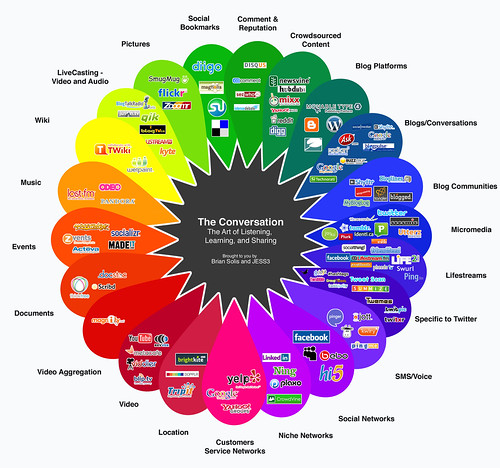
The Conversation Prism

Brian Solis is one of the most widely respected practitioners at the intersection of social media technology and PR today. A few days ago, he posted an item on his blog called Introducing The Conversation Prism which explores how virtual conversations are happening today - taking in to account all of the different social media options available.


I've reposted the image here because I think it's probably the first comprehensive visual representation of the current state of social media. Which, by definition, means that it's absolutely ground-breaking.

For most of the media's history, the mechanics of conversation were simpler - but much less democratic. Broadcasters and publishers spoke to audiences, and audiences listened. Now that audiences are able to speak as well - through any mechanism that's comfortable to them - broadcasters and publishers (and the advertisers that fund them) are scrambling to learn how to listen and respond.

Solis says in his post:
If a conversation takes place online and you’re not there to hear or see it, did it actually happen?
Indeed. Conversations are taking place with or without you and this map will help you visualize the potential extent and pervasiveness of the online conversations that can impact and influence your business and brand. [...]
As conversations are increasingly distributed, everything begins with listening and observing. Doing so, will help you identify exactly where relevant discussions are taking place, as well as their scale and frequency.
Indeed.

Sunday, July 13, 2008

Getting ready for the media

Sometimes, a great on-air press opportunity for your organization can be a bad thing. If you're not ready for an on-camera, or on-air interview, a great press opportunity can actually backfire - and make your organization look unprepared at best, and unprofessional at worst.


[photo credit: ccarlstead]

I've referred my readers to the Spin Project many times before for great, basic information about how to interact with the media. Their latest tutorial on Broadcast Media and Spokesperson Skills is another wonderful resource for those preparing to go on the air to represent their organization. There are many other, similarly useful guides available online and off. I encourage you to seek them out and use them often.

That said, no matter what reference materials you use to prepare, there is one, immutable truth about appearing on-air:
It isn’t what you say, it’s what they hear.
No matter how prepared you are, how eloquent you are, or how on-message you are, if your audience hears something other than you intended them to, it isn't their fault - it's yours.

So, how do you ensure your message gets across?
1. Preparation:
The key to any press appearance is preparation. You need to know your material so well that the lights, cameras, tough questions and combative opponents don't throw you off of your key messages. Your organization's history, mission, impact, evolution, growth and challenges are all fair game. You need to be able to answer questions about any of them eloquently, accurately, and - most importantly - in 7 seconds or less.

2. Appearance:
When you're on television - what you say is judged by how you look. Your messages will be lost if you don't appear to be credible source - no matter how much you know about your topic.

Be sure to dress well. When in doubt, be conservative. For television appearances, avoid bright colors as well as too much black or white neutral colors are best. Never wear clothing with patterns, stripes, dots or floral designs. Avoid big jewelry, button, slogans or flashy watches. Wear makeup (yes, even men) and smile. Sit-up straight, use natural hand gestures, and make eye contact with the interviewer - don't look around or be distracted by movement off-camera. And above all, stay calm - no matter how argumentative the other guests, or the host might be. It's your job to appear as the most reasonable and rational person on the show.

Some other things you can do to appear comfortable and confident on-air are:
  • Watch, or listen to, previous episodes of the show to familiarize yourself with its format, environment and audience.
  • Know the name of the interviewer and any other guests you’ll be appearing with.
  • Know the slant of the piece or topic of the show.
  • Know how long you’ll be on the air, and know your key messages (the facts you want to get across to the interviewer & audience) inside and out so you will be sure to deliver them during the interview.
  • Speak slowly - focus on pronouncing each word fully, pausing between sentences, and adding extra emphasis to key points.
  • SMILE! If you're on television you will appear to be more relaxed, and if you're on the radio it will sweeten the tone of your voice - which makes you sound more interesting.
  • Before the interview begins, warm up your voice and be sure you have access to a glass of water to keep yourself hydrated.
  • For radio interviews, be sure you're in a quiet room on a land-line with the call-waiting disabled, and be sure all other phones, radios and other devices are turned off (they can cause reverb and confusion).
3. Brevity:
Speak in a conversational tone but remember this is NOT a conversation, get to the point, speak with emphasis and be brief - good sound-bites are rarely more than 7 seconds long.
Be sure to pause so that the audience doesn't lose track of your point, and so that you don't appear to be rambling. Remember, you are the expert on your key points, speak with confidence - and avoid filler words or sentences (uh, um, ifs, ands, wherefores, maybes, etc. are more noticeable on air than they are in regular conversations).
Consistent practice, coaching and preparation will help you take advantage of the on-air press opportunities that come your way. It's smart to begin those efforts now, rather than waiting until you're scheduled to appear in the studio. When you have the chance to deliver your organization's message to thousands of viewers and listeners at once, you'll want to be sure you're ready.

Marketing vs. Conversation

Social Media Today ran a great post recently dealing with the difference between marketing and conversations.

The core message of the post was:
"Conversations are between two or more people. If marketers want to create buzz throughout the social web then they’d better represent a product/service that exceeds people’s expectations. Otherwise trying to interrupt conversations with a product or service that hasn’t performed well may in fact turn the conversations against you."
This is a key point that many organizations miss when they dive in to social networking. It's not enough to join in the conversation. You actually have to have something to say.

Social networking is not an internet phenomena - it's simply an extension of everyday conversations into an electronic medium. Just like at a cocktail party, if you were to walk up to a group of people that are already talking, you'd come off as odd if you were to immediately start speaking about something that's off-topic. Eventually the group would ignore you, and eventually they would shut you out of their conversation altogether if you didn't stop talking.

If you're trying to draw attention to your organization, project or idea in a social networking environment, begin by listening. Only chime in when you have something valuable to add to the conversation.

It's a good rule of thumb both online and off.

Thursday, June 26, 2008

The Importance of Storytelling

I spend a lot of time discussing the importance of storytelling for both non-profit and for-profit communications on this blog.

[photo credit: luiginter]

Storytelling has also been a popular topic in the advertising industry lately. Today's Ad Age ran a piece entitled: (Author)ity: The Importance of Storytelling, in which they quoted Avenue A's recently published "Digital Outlook Report" which had this to say about the subject:
'Narrative is the experience. As the Web becomes the preferred destination for brand exploration, digital experiences must become richer, deeper, and more able to tell compelling stories. If your brand experience depends entirely on pages and clicks, it's time to wonder, 'What is my story?'
The thing that continues to strike me through all of these efforts to examine the role of storytelling within the worlds of business and philanthropy, is the sense that we need to justify the use of storytelling as a mechanism.

Culturally, we associate stories with children. We relegate them to the realm of fantasy and of entertainment. We don't consider them a tool. We don't take them seriously.

In fact, though, stories are the interface to the human brain. They provide the method by which we transfer data from one person to another. They are the keyboard plugged directly into our mental CPU.

Skilled storytelling allows us to take advantage of culturally-defined shortcuts on the keyboard - making data transfer that much more efficient and effective.

When we, as communicators, use familiar storylines (like the "fish out of water" tale, or the "journey to a distant land" tale) we can skip over known quantities, simply fill in a few bits and pieces of new information, and still effectively present a complex point. More importantly, because the end of these familiar stories are essentially pre-determined, our audience is more likely to accept our story's outcome as credible if it follows a familiar pattern.

Our culture's stories create the filing system that allow us to quickly access information. They provide the tools we use to distinguish good from evil, and fact from fiction. In fact, when we encounter cultures that don't share our stories, we are often entirely unable to communicate.

Stories are not limited to childhood. They define our everyday lives. Individuals, organizations and corporations that discount their value run the risk of failing to communicate altogether.

Wednesday, June 25, 2008

Rockefeller 2.0: Gates relaunches philanthropy

What could you do with unlimited resources?

Photo credit: Denis / Redux Pictures

The Gates foundation - with $37.5 billion in cash - is facing that question now, and a number of non-profits are watching intently to see what the outcome will be.

A recent article on MSNBC.com (Rockefeller 2.0: Gates relaunches philanthropy - Giving- msnbc.com) sums up the problem, and the possibilities, this way:
“I meet many high net-worth individuals that are watching Gates and what he does and how he does it, and that’s really exciting in a behavioral way,” says Jacqueline Novogratz, the founder and CEO of Acumen Fund, a nonprofit global venture fund that uses entrepreneurial approaches to solve the problems of global poverty. “It opens up people’s minds to what’s possible with philanthropy today.” Jeff Raikes, the Microsoft executive who was recently named as the foundation’s new CEO, told Fortune magazine in June: “Bill has an incredible opportunity to help shape the thinking of other multibillionaires by getting them to think about the process, the structure, the best practices” of giving money away."

Wednesday, June 18, 2008

What to expect from PR

An excellent post today at Media Bistro by about what a company (or an organization) should expect to accomplish with PR.


To paraphrase the article's main points:
  • Set clear goals
    Create a message platform and at least six month's worth of news hooks within the first week.
  • Have more than a good story -- have the right story
    Agree on exactly what your best story is. Ask the question, 'Why should people care?"
  • Go local
    People care about their communities, so they turn to the local media to know what's going on. Local press interest will also help your organization prepare and practice for its moment in the national spotlight.
  • Connect
    Successful PR today is about having great conversations, telling people what you've learned, and what impact that's had.
  • Work the plan
    Establishing storylines and a workable timeframe that is tied to your organization's goals makes it easier to land appropriate stories in the media.

  • Don't confuse strategic PR with publicity
    Getting press too early - when your organization isn't prepared for it - can actually make your job harder and lead to lost opportunity. You risk ending up being perceived incorrectly because you aren't clear about your message, and you risk alienating key press contacts.
  • Stay up to date
    Do you know the trends in your own industry? How do you stay informed about new theories and cutting-edge technologies? If a reporter calls and knows more about your industry than you do, you risk losing the opportunity to be a part of a breaking story.
Publicity for publicity's sake should never be your goal. Clear, strategic communications planning is always worth the effort in the end.

ShareThis